Gardening

Growing vegetables, herbs, etc. in a small urban space

  • | |

    Snowdrops and Crocuses (and Spanda)

    Snowdrops have been showing up for more than a week, but crocuses?  They seem a little incongruous with the bitter winds and as much a reminder of global warming as of spring.  I feel a bit confused seeing them, though delighted.

    It has been a good winter.  I have learned to appreciate the cold and dark, which gives us time to enjoy the pleasures of home and introspection.  Now, I am looking forward to spring, the effusive colors, the warmth, the ability to get back out into the garden.

    This time of year, with the radical contrasts of cold winds and flowers does highlight the play of opposites, the very pulsation of existence — in yoga terms, the spanda.  This time in society seems to have a similar play of bitterness and sweetness.  Staying steady with our yoga practice and our community, we can delight in what we see and what we have, even as we may be worried and working for change.  That too, is part of the play (lila).  To invite in a steady warmth and support from our practice and our community, even as we see difficulties and challenges, want things to be different, and know that our work may not necessarily bring about the change we seek.

  • |

    Grandma Rose’s Philodendron

    The other day, when I was in NY visiting,  I told my mother about the blog entry on Robert’s dendrobium. (Being physically present and discussing the blog entries is the low-tech way of getting comments).  She pointed to the philodendron and some cuttings she was rooting from it and said, “that philodendron was your grandmother Rose’s; it must be 70 years old.”   It might not be 70 years old, but it is at least 40 or 50, as my grandmother left her body in 1977, and I remember her having houseplants.  It is possible, even, that the plant originally came from a cutting from my other grandmother, as that was how we obtained and grew most of the family houseplants.

    My mother offered the plant for me to take home.  I declined, but thought about taking a cutting.  By the next morning, I had forgotten, but I will take a cutting one day.  I did not need the cutting to enjoy thinking about bringing home a bit of life that had been living in my grandmother’s apartment and remembering both my grandmother and a space that I had loved.  That was delightful enough.

    (ps — one of the many reasons for the name “rose garden yoga” is in honor of my grandmothers — for my grandmother Rose’s name and for the love of gardening I learned from my grandmother Ann).

  • |

    Rain (not quite enough)

    It was wonderful to get some rain yesterday, but our area really has been way too dry, suffering from storms going to the north and west or to the south and east of us.  Here are a few ways for those of us staying on the grid to reduce water consumption:

    1.  Short showers (under three minutes)

    2.  Longer showers or baths only an occasional treat.

    3.  If you have space (I don’t; though I keep thinking about how to work it) get a rain barrel or two for your garden.

    4. Re-use water when you can.  For example, when changing a pet’s water dish, water plants instead of pouring out dish.  Soak pots without soap (needs longer soaking) and use soaking water for house plants.  Same for water from your hot water bottle (to stay warm while keeping the heat down).

    5. Practice the old drought adage all the time (“if it’s yellow, let it mellow”).

    6.  When it is time to replace a toilet or faucet, use a water efficient model.

    7.  Turn off the water while brushing teeth, shaving, or lathering.

    8.  For container plants in the garden, use “Soil Moist” or a similar product.

    9.  Drink tap water (it takes about 60 ounces of water to bring you a 20 ounce bottle of water).  If you don’t like the taste, filter it.

    10. Forget about washing your car (if you have one) except for keeping the windows clean enough so you can see out.

    11.  Replace lawns and annual flowers with hardy, native perennials.

    Please share your tips.  I’m always looking to learn.

  • |

    Daffodils

    Daffodils and tulips have arrived in the shops.  If you’ve forced bulbs (I didn’t this year), they are blooming (give or take a few weeks).  The arrival of the Dutch flowers and the forced blooms lets us know that spring is soon to arrive.  If you look carefully, you can see that the early bulbs are starting to come up.  If you are lucky enough to have them growing in your garden or a neighbor (who wants to share), it is a great time to bring in forsythia and pussy willow cuttings for forcing.

    How wonderful to enjoy these harbingers of spring in the last few weeks of winter.  I get a similar feeling when I am given an assist to be able to do a yoga pose that will be out of reach for me to do by myself for some months or perhaps longer.  When an assist opens me to an understanding of how I can grow, just as the arrival of the dutch bulbs and the forced flowers give an early reminder of spring, my heart opens.  Given this inspiration, this understanding of the possibility of growth and flowering, I am inspired to turn around and share this delight with others.  How could I not want to share?

  • |

    Robert’s Dendrobium

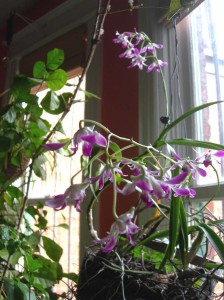
    roberts-dendrobium2A number of years ago, when he was moving from Capitol Hill to Denver, my friend and former neighbor Robert gave me this dendrobium orchid, which bloomed this year for me for the first time.  The dendrobium was just an extra.  If you know orchids, you can see that it is planted with a vanda.  These orchids came from Robert’s mother’s garden in Florida.  When she had to give up her place in Florida, Robert brought home some of the orchids, including the vanda.  If I know Robert, he just saw a baby dendrobium in the garden and stuck it in with the vanda when he carried it back north to Capitol Hill.  When Robert moved to Colorado, he left the vanda with me because he did not expect it to tolerate the Colorado climate.  Even here, the vanda is not likely to bloom.  Not enough heat, light, or humidity in DC (really!!!).  But after five or six years of steady care, the dendrobium flourished and finally bloomed.  Robert inspired my affection for orchids; he had a greenhouse and knew each one of his tropical plants intimately.  We would go to an orchid show or nursery, and he would look with love on each and every plant, cherishing their individual traits, no matter how small or large.  At the botanical gardens, he had different plants he visited and enjoyed.  Now his yard has cactii and peppers.  He has a few of his most faithful orchids, which are flourishing and which were delightful to visit, and I have this lovely reminder of a time when Robert was one of my local gardening buddies.  This, I think is one of the extra joys of gardening, especially with houseplants that come from cuttings.  They have a history with our family and friends that is passed on, cherished, and shared.  I also have a night-blooming cereus that was a baby from a plant that started as a baby of one in his mother’s garden.  The night mine first bloomed (just a single night in the year), the parent plant with Robert in Denver also bloomed.

    Bonus love from this particular dendrobium; it is scented!

  • Cabbage Butterfly

    I was sitting at the kitchen table editing a document and drinking hot tea, when I heard a beating of wings against the window.  It was in the inside, not the outside.  A cabbage butterfly.  I do not know how it got inside or where it found a place to grow and open in the house, but here it is in the middle of winter.  It soon gave up beating its wings against the window and found the orchids that were blooming and rested there.  What a lovely surprise.

  • |

    Sunshine?

    I was talking to my Dad earlier today.  My parents live on Long Island, where they are in the middle of getting three to six inches of snow.  He said that the weather forecasters indicated that they were just missing having a blizzard, and he was grateful they were not.  For the same reason Long Island is not getting a blizzard, we are seeing sun instead of a couple of inches of snow.  We actually needed the snow.  Last week’s ice was the first precipitation in almost three weeks, and now, once again, a storm has shifted away from us.  It is good to see the sun, but it would be better for the trees to get some rain or snow.

    We get what we get and then we have to choose whether to be happy or sad about it.  I am happy not to be shoveling.  And the chard is starting to come back.  Next week, with highs forecast in the 40s and 50s, I’ll be harvesting again.

  • |

    Ice and garden greens

    Went out into the backyard despite (or perhaps because of) the freezing rain.  The greens had a thin coating of ice, but were still bright.  Picked big handfuls of mixed asian greens, arugula, and chard.  The ice cracked off as I picked them.  Later in the morning, I will saute the greens with tofu for a nice brunch.  I have dough rising for pizza for the neighborhood solstice open house.  I think about making crackers.

    Tomorrow, some of the greens growing will be frozen food.  I’ll make an italian bean and greens soup with those leaves.  When it gets back up to 50F, which it is supposed to do within the 15-day forecast, there will be new growth.  The chard just might make it all the way through the winter.  The arugula — it’s less likely.

  • |

    Putting the Garden to Bed Sun Salute

    Yesterday (latest in the season ever — see interesting articles in the New York Times last month about Thoreau as a climatologist) I spent the morning bringing all my tropical plants inside.  Part of the reason it was later is that I have learned that the orchids and night-blooming cyrius like nights in the low 40s and can tolerate the occasional single night in the high 30s, but most of it is that it is a warmer season than any in the decade I’ve had a significant number of tropical plants.  I also bring inside the lemongrass and lemon verbena (annuals here; perennials where they are native).  I also like to bring in rosemary in a container.  Also, what were once small plants in growers pots are now a huge jasmine and a bay tree.  When I bring all of this inside in the winter, I transform the house into a retreat.  When I bring it all outside in the early spring, my tiny yard is full and lush before the annuals start flourishing.

    Once the tropicals were all inside, I cleaned up, tended the beds and containers, and strew some more winter kale and baby spinach seeds (no frost in the forecast for the next 15 days — so I could have new kale and spinach through December; also, some of the seeds will wait and be the early ones that come up during that warm week we always have in February).

    Putting the garden to bed has a sweetness to it.  I prepare for next year, but also engage in tending what will flourish best when the days are coldest and shortest.  It is a going inside, knowing that there is a need to go inside and let some things be dormant in order to flourish fully when the sun is bright and hot and calls me outside.

    This type of gardening is stressful for the lower back, hips, and shoulders.  Throughout the hours I am gardening,  I like to engage my alignment by intermittently doing some poses, strongly integrating my shoulders, hips, and core:  working strong “shins in/thighs out” I practice uttanasana (standing forward fold), utkatasana (chair pose), and adho mukha svanasana (downward facing dog), and maybe even handstand.  It is critical to make sure not just to bend from the knees, but also to make sure you have a good lumbar curve and your tailbone is tucked, when picking up containers or other heavy objects.

    At the end of several hours of gardening (bringing the tropicals inside also entails vaccuuming), I need to realign, stretch, and reintegrate, but I’m tired.  I also want to practice in a way that honors and celebrates the sweet inward nature of the work I have just done.  This is what works well for me:

    1.  Seated foot massage.

    2. Balasana (child’s posture) with arms stretched out, palms, forearms, and armpits lifted.  Inhaling lift underside of arms to strenthen, exhaling soften between shoulder blades to integrate.

    2. Chakra vakrasana (cat/cow breathing).

    3. (putting the garden to bed sun salute):  Table pose (if you make sure you have good lumbar curve, table is one of the best postures for making sure hips, back, and shoulders are aligned well); Downward facing dog (play in the pose to integrate and stretch the legs and arms and strengthen your core); Palakasana (plank);Table pose; Balasana;Table.

    Repeat the series several times.  Add in lunges (coming into the lunges from table).  Add in twists from table, threading one arm through and coming down onto that shoulder).  Add in pigeon pose (with a forward bend).

    4. End with legs up the wall, a supported or seated forward bend or two, and savasana.

    Enjoy how this practice nourishes and realigns, but generally draws the attention inside, getting you ready to enjoy the inside while waiting for the next growing season.

    E

    ps While I was practicing, I had a big vat of tomato sauce cooking from the last (perhaps second to last) harvest of cooking tomatoes.
  • |

    Adhikara

    I was first taught that adhikara meant “studentship.”  Although that is not a literal translation, adhikara implies a dedication and steadiness in the student that makes the student worthy of receiving the teachings (of yoga).  As I was steadying myself during this momentous time and working in the garden, I was thinking about how the principle of adhikara applies to so many aspects of life, including gardening and being a citizen.

    One of the literal translations for adhikara is “competence.”  What is the competence one needs to have in order to participate in the study?  As I harvested the last of the peppers and eggplants and pulled up the plants, making room to sow another round of greens (not too late in my sunny, protected yard in the city), and decided to leave the orchids out for another week, I thought about how I knew what to do when in my garden.  By being present and observant for two decades in my yard alone, I have grown competent to know what will likely grow in my little patch of earth and for how long into the season, depending on the year’s weather.  My initial competence, when I started this garden almost 20 years ago, was some basic training in other gardens, reading technical books, and enthusiasm.  My consistent efforts to learn yielded results delightful to me from the beginning.  As I have continued my studentship in the garden, my appreciation grows.  The same is true for me also with cooking, relationships, and my participation in the community (not necessarily in that order).

    The fundamental competence of a student is having the basic skills to participate at the level of the teachings.  For a gardener, it is recognizing our climate, our space limitations, and our soil, and being open to learning what can be changed in a particular space and what must be accepted.  For a citizen, it is knowing basic civics, what are the most relevant issues for us and society at large, and what we can change and what we must accept (I think knowing the subtle differences between what we can change and what we must accept is incredibly difficult).  For yoga, it is much the same:  we must know what are true limits and what are false ones and be consistently present, practice steadily, and be ever open, not only to studying, but to the fruits of study (expected or not).

    I cannot change the weather, nor guarantee how other voters will vote, but I can continue to maintain the adhikara necessary to be a fully engaged student of this life on all days and not just the days it is fun or gratifying.  The yoga, on a day like today, is to act fully, accepting, and perhaps even appreciating, the limits on what I can control.