Asana, Pranayama, and Yoga Practice | Food for the Mind (Yoga Philosophy, etc) | Meditation | Photos
Drive Home

Peace and light, E — Posted with WordPress for BlackBerry.
Peace and light, E — Posted with WordPress for BlackBerry.
Those of you who are regular readers may sometimes wonder why this blog, which purports to be about yoga, only on the rarest of occasions goes into any detail about the physical alignment principles for asana. I just received a comment on a post that I wrote several months ago that reminded me of my conviction that the optimal place to discuss and practice physical alignment principles is in class. This conviction is not because there isn’t value in reading about the alignment principles–I look at the Anusara Teacher Training Manual on a regular basis–but because it is critical to understand the bigger picture, to have a loving eye on the alignment, and the opportunity to ask questions right away, which we can only get when we practice with a teacher. In this instance, the commenter said in response to a post in which I had indicated that “thighs out” was shorthand for part of inner spiral that she had heard that “thighs out” in the common Anusara alignment instruction “shins in, thighs out” was just hitting the thighs apart and was something separate from inner spiral. Would I mind clarifying.
I found the comment timely as I was recently at a workshop where the teacher had noted the injuries that can flow from overdoing an isolated action that is intended to describe one part of an element of the basic principles of alignment (in that case “taking the armpit back.”) I agreed with the teacher that just jamming the armpits back can stress the shoulder and limit freedom if it is done in isolation and as the first action in a movement involving the shoulder girdle. It can be an incredibly helpful alignment instruction, though, if the students recognize (as reminded by the teacher) that we don’t take the armbone back without first opening to grace, including softening and expanding and making the “inner body bright” and also practicing the movement in a way that recognizes the point of the instruction is to encourage students to integrate the head of the armbone into the shoulder socket by means of muscular energy.
Like taking the armbone or armpit back, I do not believe that taking the thighs apart should ever be treated as an isolated point of alignment. It should only be done in proper sequence and in proportionate action to the amount the yogi is able to work the other principles. “Shins in” should not be done without first opening to grace, including softening, expanding, listening to the body, and establishing a good foundation. It is also only one of the three aspects of muscular energy. “Shins in” is just one way a teacher might tell students to apply the principle of hugging to the midline, but the student should not neglect hugging the muscles to the bone or drawing energy from the periphery to the focal point of the pose just because the teacher only cued “shins in, thighs out.” After all, there are only so many words that can be said in a single class and only so much on which we can focus at a time, but that does not mean we should be neglecting the basics as we seek to become more refined in our practice. Just as “shins in” is only part of muscular energy, the companion shorthand instruction “thighs out,” emphasizes just one aspect of inner spiral — that which serves to broaden the broaden the pelvic floor by means of the movement of the thigh bones. That does not mean that it is independent of the other aspects of inner spiral–spiraling inward and expansively from the feet upwards and taking the thighs back, both of which sequentially come before the “apart.”
Wow. For those of you who read this for the gardening or cooking or to enjoy the photographs, this level of detail might seem mind-numbing. Part of the danger of getting into the weeds in writing about alignment is just that. Not only is it distancing, but it gets educated readers into a space of debating the finer points and wondering whether things have been said just right. It becomes far to easy to lose sight of the point of yoga in the first place, which is to bring us joy on and off the mat. Remembering the intention to cultivate joy (ananda) when we are practicing actually physically protects us from getting in trouble by over-efforting with regard to one small aspect of alignment. When we are (sat) consciously (cit) in the moment with an intention to cultivate bliss, then we are much less likely to do any physical action so hard or so precisely that we forget the big picture and how the principle or the pose fits in with the overall flow and alignment principles and do more harm than good.
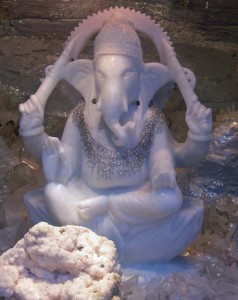 Today is a good day for me to contemplate on the Ganesha archetype — the one who places obstacles in our way and gives us the wisdom to know how to remove them or avoid them. The obstacle I can see; I’m at the needing wisdom stage.
Last night I went to see the National Theater UK’s simulcast (tape-delayed) of Helen Mirren performing in Ted Hughes’ translation of Racine’s Phedre at the Shakespeare Theater. The tragedy of Phedre is misinformation, misguided helpers, and passion that has gone beyond sweet engagement to maddened attachment.
A stage production is intimate and designed for the small audience of those present in the theater. When it is merely filmed (instead of being turned into a movie), it sometimes feels forced because it is watching a film of a stage production, instead of being invited in as one is when one is either at the stage production or the filming is done as a movie, which is designed to include the viewer in a manner for the film.
What was hard about watching the filming of the stage production, was being forced to have the camera’s and director’s perspective; there was no ability to turn my head and shift which part of the stage to give my attention. At the same time, I felt appreciative of the miraculous offerings of technology: the filming made something that is usually limited to those who can afford theater of that extraordinary quality and who are able to be in a certain place at a certain time available to tens of thousands around the globe, including me and my friend. In that way, the filming both took away the intimacy of being physically present, but simultaneously created a unifying experience for a much bigger group of people.
I was inspired to think about the limitations and differences among the perceptions of the characters, of the critics (talking about the play and the film), of the smaller, elite audience (the actual theater goers’ — I’ve been at that theater in London), of the technologically broadened audience, and of mine in response to the essence of the tragedy, the story and substance of the play, the delivery of the play, and my own life as informed by the play.
It seems an interesting lesson on many levels on how we can choose to live with our passions, how we can react to limits and changes in our ability to perceive our own selves and the world around us, and on how and what we invite in through the doors of our perception.