Asana, Pranayama, and Yoga Practice | Community and Family | Food for the Mind (Yoga Philosophy, etc) | Quaker
Self-Reflection With Found Exhortation

There were lots of images of Hanuman around where we were in the hills. I come home after this long break–far enough away and for a long enough time to be able to gain perspective–and think, given that I have dedicated most of my career to public service, about how the myth of Hanuman may inform my ongoing contemplation at this time in my life and in this socio-political climate of how I can best contribute and participate.
Hanuman is the faithful servant; I think that one aspect of his story is that in being true to Rama, he is being true to dharma, to law and culture. In loving and protecting Sita, he is recognizing nature. Only when he is acting in service to them and others can he access his true powers (siddhis).
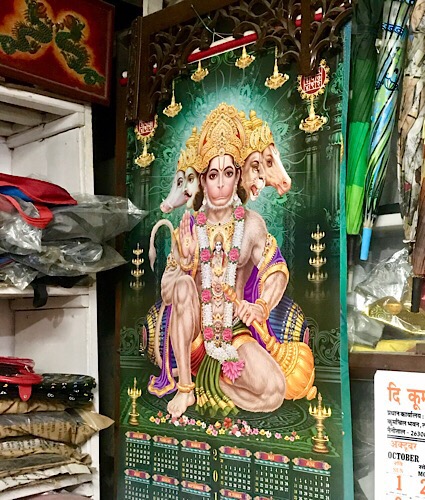
Inside the Durga store, Nainital, India, October 2017
This morning, when I was walking to work, a young mother stood on the sidewalk talking with a friend. Her daughter, who was perhaps a little over a year and new to walking, lit up with a huge smile when I came within range. She dropped her mother’s hand and ran over to me, holding out a flower petal. That her hand was slightly grubby and the petal crumpled only made it more adorable.
Nearly eleven hours later, as I get ready to leave the office and head up to Takoma to teach a restorative yoga class, I find myself recalling the offering, with such innocence and joy, of the flower petal.
What we want to do with our practice and teaching is to have it be, at least on one level, such a spontaneous, delighted, and innocent offering that any perceived obstructions or interference with a sense of grace (such as a long hard work-day and attendant fatigue) dissolve. We can melt into the knowledge that practicing and making offering is just the right thing to bring us back to our own fullness (purna).
What we choose as the particulars of the practice, of course, will be tempered by our physical and mental condition.
Peace and light, E — Posted with WordPress for BlackBerry.
Every day we begin as yoga practice, we begin for the first time from the place we are in. We have another opportunity simultaneously to critically assess and more optimally align and accept how we came to be in that particular moment on the space-time continuum.

A couple of weeks ago, a good friend gave me a box of perfect vidalia onions. She had been given two boxes. She said, “These onions were so good; I wanted to give them to someone who would truly appreciate them. I first thought of you.” I was delighted, “yes, I’d love some vidalias.” They are exquisite. I’ve been making delicate sautes, grilling them, dicing them into salads, and marveling at their sweetness. I passed a few on to others that both would fully appreciate the onions as a culinary matter and also know my friend, who is a former co-worker.
Last night I went to take class at Willow Street and was talking a little with the work study students at the desk after class before heading home. “Would you like some onions?” asked one of the work study students, who does great work with the Fresh Farm Markets around town. “Oh, how lovely, no, no thank you,” I replied, “A friend just gave me a box of vidalia onions and I have shallots, baby leeks, spring onions, and garlic chives in my garden.” “I think you have enough in the allium family already,” she agreed, “would you like a cucumber?” “A cucumber? Yes, that would be great. I’ve only gotten one ripe one so far; they aren’t liking the cool wet.” She gave me a cucumber and a zucchini from a farm visit she had done that morning, which made my evening (I am so easily pleased).
This morning I wondered about these offers of onions. It is not as though it is a regular thing for me twice in a space of a couple of weeks to be given bounteous offers of exquisite onions. Did it mean something?
Onion comes from the same latin root as “union.” Unlike garlic, in whose family onions belong, onions grow a single, undivided bulb, which is the likely reason for the development of the word onion. From sketchy researching on the internet, I find onions are also the symbol of “good” and fullness — hence the onion domes in architecture. The ancient Egyptions thought the onion a symbol of eternity (layer upon layer of being) and truth. Yes, I like thinking these onions (those I took home and those that were gifted instead, no doubt, to some other appreciative soul) were meant to bring me to think of good, of union, of the eternal truth in gifts and shared pleasure in sharing delicious, healing, fresh food with friends.