Samsara
From a German language spammer advertising “female viagra” comes this bit of universal wisdom on a day when I found myself needlessly anxious about a mistake that was fairly easily rectified: “It sounds like you’re creating problems yourself by trying to solve this issue instead of looking at why their [sic] is a problem in the first place”
If I were one who just trusts naturally that many simple things can be fixed easily if I just ask for help, there wouldn’t have been any need to be anxious. It would have been better not to have made the mistake in the first place, but as much as I might dislike it, I will inevitably make mistakes–here, not getting my dates right for asking for sub coverage for a yoga class. With the wonderful community in which I am blessed to be a member, it only took a few phone calls to work things out.
It is one of my biggest challenges to have to ask for help. Having to ask for help because I made a mistake made it even more challenging. A big part of my yoga is learning to soften and trust in such situations. When I did just that, I not only was able to ease away from needless anxiety, I was able to allow in more love and support. Sometimes we need to be put face to face with our toughest stuff to open at another level.
I saw a hawk when I was walking to work this morning. It was in one of those stately oak trees in the park just north of the US Capitol. I have occasionally seen hawks in the neighborhood alleys, but never one at the Capitol. The hawk stood out for two reasons: it was very large, and it was the only living being about. Usually, there are a number of squirrels, pigeons, and maybe crows, sparrows, and common grackles about the park. This morning, it was unearthly quiet; all of the other animals and birds were all in hiding. It was probably a red-tailed hawk. As I stood to watch this special being, a woman walked past me with her head hunched down, her hands shoved in her pockets, her briefcase weighing down her shoulder, and her face preoccupied, a common going to work look. I called out to her, “look, a hawk.” She was startled, maybe even a little upset at first that I had interrupted her thoughts, but then she, too, stopped and watched. When I finally continued on to work, she stayed watching for a while, and she no longer looked preoccupied. At the bottom of the steps of the park, I went past the police, who are there every morning with their cars parked on the sidewalk (blocking the way). The police rarely say hello. One of the cops, who had his dog out of the car, called out a good morning to me today, though. I greeted him back, “good morning, did you see the hawk?” “Yes, I’ve been watching it,” he said. We had a nice chat about the hawk and about his being able to watch the bald eagles at Blue Fields in Virginia, where they do the training for the police dogs.
It would have been easy for me not to see the hawk. I use my morning walk as a time for contemplation, and when I am in the park (leaving aside the Architect of the Capitol vehicles that sometimes intrude), it is a time I can be less careful about traffic and be more inward. But it is also a time to look and to appreciate the opportunity to be outside, whatever the weather and the season. The trees and birds and small animals and plantings and sky look different everyday. While I go inward on my morning walk, I am also always noticing. This is a kind of mindfulness — to be able to be resting with inward attention, but still be open to observing whatever is in view. Is it less mindful to be so drawn inward that the outside disappears? That perhaps depends on whether one has deliberately gone so far inward that the outside ceases to exist for a time, which is a meditation method, or whether one is just so preoccupied with the churning of the mind that one becomes less conscious.
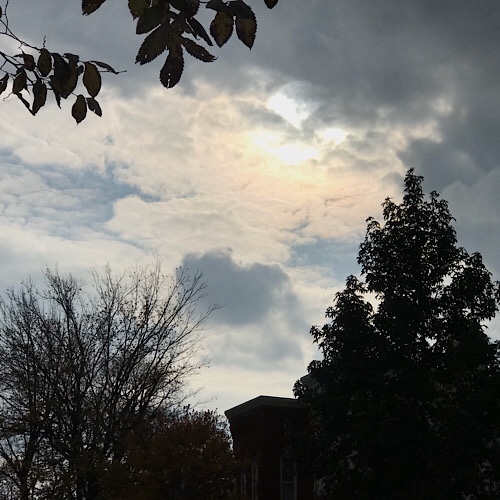
While what was going on down on the surface of the earth was going on, the sky was a play of light and shadow.

In the yoga stories, all of those who work, who commit to the arduous practices get boons, including the demons. If it looks like the demons are winning the day because of their efforts, the only way to change the game is to commit and surrender more deeply to our own work and practice.