Art and Culture | Asana, Pranayama, and Yoga Practice | Community and Family | Food for the Mind (Yoga Philosophy, etc) | Meditation
Signs Around Town (and Bhakti?)

In classical yoga, maya is the illusion that the tangible world is what is real. Only atman is real; the world we experience through our senses (and our senses them selves) as reality is an illusion. We renounce the world to escape the temptation of being drawn into it as reality. In so doing, though, we ineluctably must come to the conclusion that all that is ill with the world is as much an illusion as that which is tempting. In turning away from the world we would be also turning away from the pain of seeing inequity and suffering and the desire to seek change in the tangible, sense-experienced world.
As I was walking around New York City, ankle-deep in slush and being hyper-stimulated by the lights and the noise and the smells and the bustle and the choices, I found myself thinking about maya and that in its classical sense has two surface temptations for me. The first is the temptation to turn away from the stimulation, to reject consumption of more than needed to exist. In the face of such excessive stimulation, the idea of nothing, of utter simplicity, of quiet seems desirable. If the turning away is another form of seeking pleasure or escaping pain, though, it is still in the trap of maya — the worldly illusion that binds us in the pair of opposites–pleasure and pain. The second temptation, the temptation to withdraw from everything except seeking the light within, is more subtle. If we truly are to turn away from the world of the senses, we turn away from notions of justice and equality and freedom that are based how we live in the material world as much as we turn away from consumption.
The true path of renunciation, of pure meditation, is a rare and beautiful path, but to stay in the world and to withdraw ineffectually in such a way might earn the hackneyed epithet “navel gazing.” My path is not that of the renunciate yogin, nor do I have the fortitude to live a life of Christian poverty, which would reject riches and live for service. Where can we find the support in the yoga path to stay engaged and yet still live mindfully, fostering the expression and recognition of spirit in ourselves and others?
In tantric philosophy, maya is understood somewhat differently than in classical yoga. The maya is not the world itself. When we think that getting and having and avoiding is all that there is and that it is separate from spirit, then our lives are cloaked by maya, and we are ignorant (avidya) of the true bliss of spirit (satcitananda). To know spirit, we must see through maya. To do that requires discrimination (viveka) in what we take into our senses and ethically responsible action in the tangible world to align our lives in a way that expands the opportunity to recognize spirit, which in my mind includes having less material disparity in society, which disparity most assuredly makes the essential truth of blissful consciousness more opaque (due to the play of maya) for both the haves and the have nots. While we make our attempt to live with more discrimination and grace and with less cause of conflict or suffering (doing better some times than others), we still try to recognize and savor the exquisite divine in each sight and taste and sound and creation. How extraordinary always is New York in all its wild manifestation!
Today I was filled with grief and anxiety, having taken in the pictures of India and Palestine and Iran and New York and Italy and for-profit prisons in the US and cages of refugees at the border and the over-burdened and under-supported health care workers and and and. And being out walking is strange.
First, I counted my blessings. Then because I know what helps me, I did it:
I sat myself down and did pranayama and meditation, made healthy simple meals, worked with focus all day, gave more money to those out helping and trying to change things for the better, spent some time cleaning and gardening, and soon will return to practicing, putting aside the influx of information for the remaining hours before bed.
Blessings to all of you.
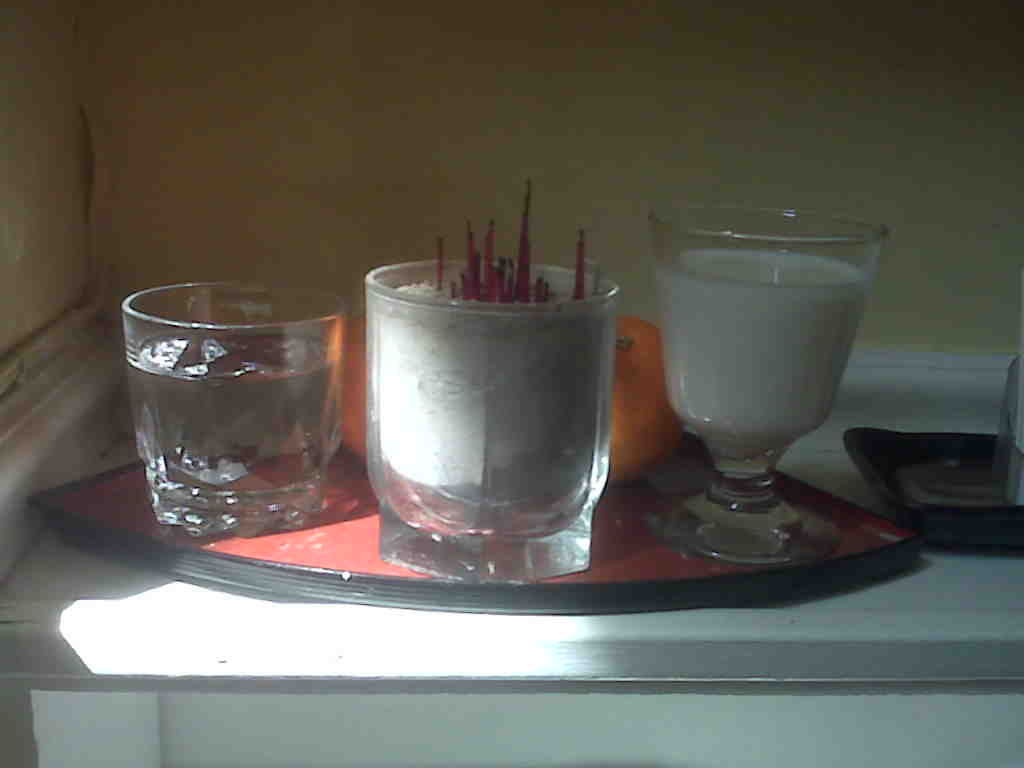
I am in a different part of town for an educational conference. I had lunch at a Japanese restaurant where the sushi chefs were prattling to each other in Spanish. This offering was in the waiting area; to whose gods, I wondered?
Peace and light, E — Posted with WordPress for BlackBerry.
Dear Friends ,
As I went through the airport in each direction last week on my way to and from San Francisco to play and to visit with friends, I thought about how much our experience even of something as relatively ordinary as a trip through the airport can change by the difference of 15 minutes. On the way there, we got to the gate just as the flight was boarding. Had we been earlier, we would have sat in a crowded area, perhaps wondering whether the flight would actually leave on time or whether we could leave from home a little later next time. If we had been 15 minutes later, we would have been among those frustrated and harried late boarders whose bags end up over some seat 15 rows farther back.
We each have our own tolerance for sitting and waiting or being at the last minute, respectively. We go through life more easily if we pay sufficient attention to what makes us feel challenged and what makes us feel secure and grounded with regard to how we navigate time and space and figure out how to act in ways that are most supportive (without dulling awareness or denying how we could benefit from change and growth).
An important aspect of meditation and asana practice is how they can deepen our understanding both of how we tend to relate to things in our time-space continuum and how to optimize those relationships. For example, part of learning to sequence a practice is learning how the parts of our body fit together and how to change the order of movements to expand our strength and flexibility beyond what might otherwise have been possible in a safe and joyous way. In all my classes, I emphasize how to structure and sequence your own practice because I think it makes such a difference on and off the mat.
What triggered all this thinking about what a difference 15 minutes can make was that students have been asking for a later time for the Friday night gentle/therapeutics class at Willow Street Takoma Park. Starting this Friday, September 14th, class will begin at 5:45pm and end at 7:15pm–15 minutes later than it has been in previous sessions. The extra 15 minutes later start time can make all the difference in being able to get to class without feeling pressed. Ending only 15 minutes later still leaves open much of the evening. The class is a lovely way to transition from week to weekend–a Friday yoga happy hour and a half that is designed to heal and nourish. Although it is best to sign up for a class to get all the benefits of the progressive teaching method at Willow Street Yoga, drop-ins are always welcome. Do feel free to invite friends or family to join you.
New students of all experience levels are always welcome at the Tuesday night, William Penn House practice. Come by some time and join a wonderful, welcoming group of yogis. For more information, please check the classes page of the website.
Hope to see or speak to many of you soon in person or in the ether. And remember: spending even 15 minutes a day in meditation or yoga practice can make quite a difference in your relationship to life in time and space.
Peace and light,
Elizabeth
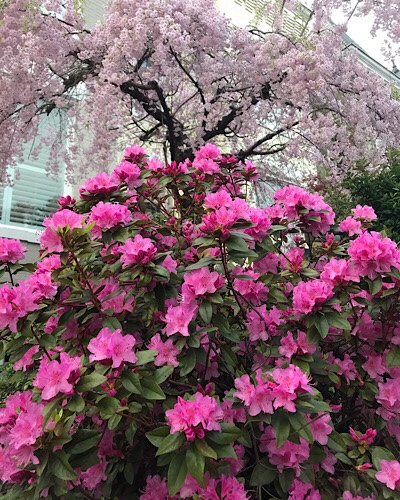
Has anyone else in the DC area noticed that the witch hazel has been especially exuberant this year? Could it be a message that nature is offering up extra soothing, anti-inflammation, and cleansing with the spring flowering? Might we take the hint that we’re all in need of healing and time for grieving even as we must persist?

Last week I attended a work-place training entitled “Conflict Management–Dealing with Difficult Conversations in the Workplace.” I do not do much training at work; the several hours a week I spend doing professional reading generally satisfies the needs of my position. When the offer for this two-day training came into my inbox, I decided that it might be useful. I am responsible for a project that involves several different offices in multiple government agencies all of which have perceived differences in agendas and jurisdiction and real differences in expertise and personality. I am also about to get another new supervisor, and people in my division have been edgy.
The training, which had about 15 attendees even though it was the Tuesday and Wednesday before Thanksgiving started simply enough. We all identified ourselves by name and job function and where in the agency we worked and then took the Thomas-Kilmann Conflict Mode Instrument, which helps give a broad general idea of how one typically reacts in situations that involve conflict. All pretty straightforward workplace training stuff. Then the facilitator suggested that most conflict between people (and within ourselves) arises when our feelings of worthiness are or are perceived to be threatened. My ears perked up. “Anavamala,” I thought. It’s just like what the tantric philosophers teach us, that the unreal cloak of unworthiness is what leads to suffering and discord.
The workshop continued. We did some roleplaying and engaged in discussion to consider how we can better lead the best out of each other and ourselves, whatever type of negotiator we are. It was interesting to see how this fairly diverse group of workers — young, old, experienced, brand new workers of varying levels of seniority in the agency — were able to be engaged and brought together in exploring these issues, but nothing was particularly surprising. It was almost time to break for lunch on the first day, when the facilitator asked, and then let drop the question, without discussion or seeking a response, “what about love?”
“What about love, indeed?” I thought. That’s a word we do not hear in the workplace unless it is in an interview and someone claims to love their work, or it’s idle conversation and someone declares that he or she loves a sports team or a restaurant. The next morning I commented privately to the facilitator that I thought it a great question, but was not surprised, given the context, that he had not discussed it further. He said that he would bring it up more, and he did. He suggested that when we love, we are more willing to allow, respect, and listen to differences of opinion; when we love, we are also more motivated to resolve conflict in a way that serves best those with whom we are in conflict. This teaching made sense for most of the participants with regard to conflicts with friends and family, but it was harder for them to see in the context of the workplace because they did not think of love (as this society has come to classify it) as something that is part of the workplace.
How can we bring love into our non-intimate relationships (although I would argue that in some ways, the workplace is very much an intimate relationship as it so deeply relates both to our sense of purpose and to our survival)? The tantric teachings suggest that there is a universal ground to all being, one aspect of which is, in essence, love (prem). When we recognize that we are all made of the same stuff and that an aspect of the universal is love itself, then we are invited to see the unity in diversity and to respond in the highest in the face of difficulty or challenge. (Quakers similarly teach us to recognize the light or good in every being and to treat all as divine). Truly loving universally does not necessarily come naturally and can be a challenging and advanced practice , but it has been my experience that it is a practice that is worthy of all our relationships, including those in the workplace. It may be too much to ask us to like our co-workers, but seeking to recognize that they are worthy of love can go a long way to making our work day a brighter, more productive, more effective, and more compassionate place.