Of Course I Was Attracted to the 330 million (Var.)
This was the kind of imagery lying around the rooms of the cool older kids when I was starting to form my cultural consciousness.
This was the kind of imagery lying around the rooms of the cool older kids when I was starting to form my cultural consciousness.
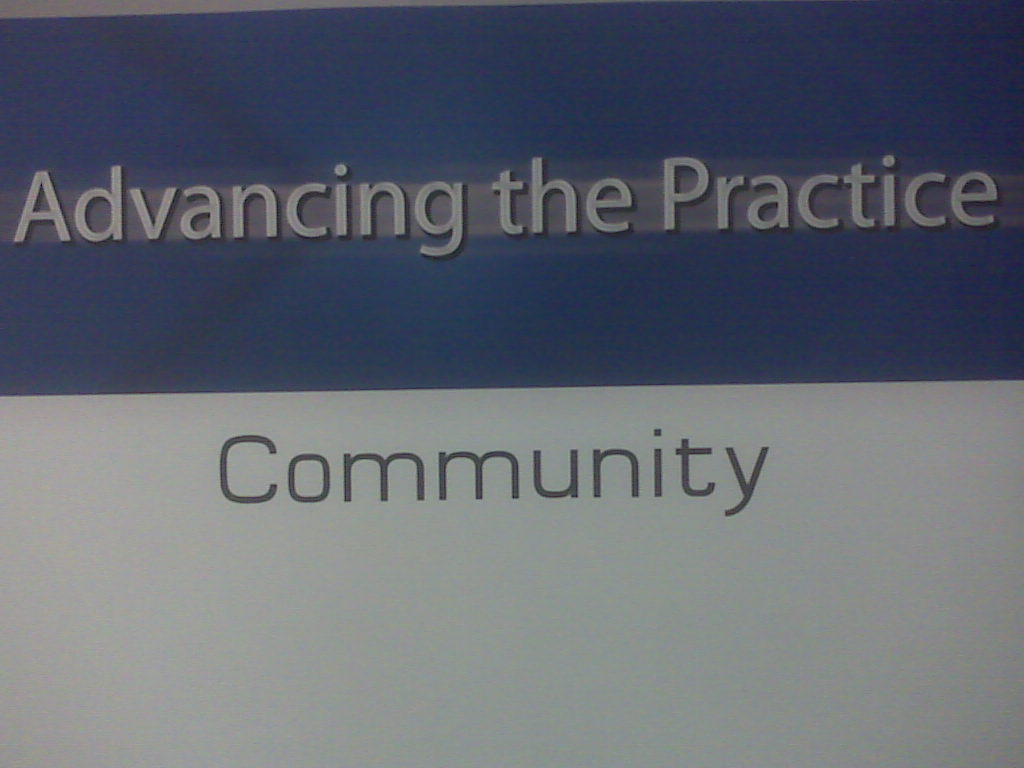
Advancing
The practice.
Community.
I spied this sign yesterday in the exhibitor hall on the lower level of the Marriott in Woodley Park. I was attending a portion of the 38th Annual Conference of Enrolled Actuaries. (Go ahead: I dare you to put that into your favorite search engine).
Although this sign was to invite enrollment in one of the actuarial professional organizations, it seems most similar to the stated aspirations of various yoga groups and schools.
I’m not surprised by this symmetry. I think that anyone who seeks to live so that employment and dharma (aligned life) are in harmony and who supports, participates, and works in community, is living like a yogin, though perhaps never knowing about or having any interest in yoga per se.
There are many life paths and humanistic and spiritual practices that guide life towards a contented path of service, the true reason, to my thinking, for a steady, long-term yoga practice (including asana, pranayama, and meditation).
I personally find the yoga practices to be among the most helpful ways to engage my body and mind for my health and well-being. Among other things, the practices have helped me listen with open enough awareness to be able to comprehend with my law-trained mind some small portion of the language of actuaries.
Peace and light, E — Posted with WordPress for BlackBerry.
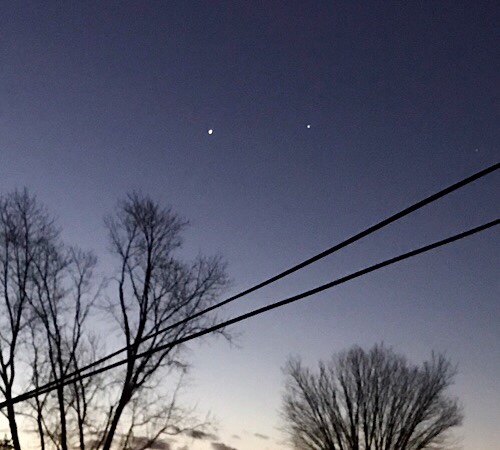
It’s a lovely meditation on perspective–seeing two planets so far apart seem so close to each other and also so much closer to us than usual.
I think some of the sense of surprise is because most of our two-dimensional depictions for explaining the planets show Earth between Venus (the near planet allegorically associated with love and connection) and distant Jupiter (the weighty one, the guru planet).
How could I be facing, the two together, as if they are far closer to each other than each to me, and nothing else visible but clouds at the eastern horizon and a setting half moon to the west?
I returned home yesterday from teaching my Willow Street classes and having a late lunch with a friend to a message on my answering machine from my mother advising me that a cousin had died. Although I was not close to my cousin, her parents, my great Aunt and Uncle, were a significant part of my formative years.
As I made telephone calls and sent emails to get coverage for work meetings on Monday and care for the cats so that I could leave for New York, I found myself flooded with long-ago memories of my cousin, my family, and myself. I could also hear and feel old patterns surfacing, as they tend to do in such situations.
In counterpoise to the tumble of memory, I felt a strong pull to go into the space of meditation.
In the spaciousness, I no longer feel trapped by the inevitable consequences from the events giving rise to all those memories that have partly shaped my path. The light of consciousness itself, as the ground of the play and the illumination of inner space, begins to reveal the links and sequnces of the memories, the cause and effect, thus allowing me to see other ways to react. Instead of remaining entangled by trying to dismiss or reject or cling to any part of my history, I could see shapes, sequences, and opportunities.
At lunch, one of the things my friend and I had been discussing was the idea of bringing into “luminous spaciousness” our relationships. John Friend had invited us to think about that concept at the Teachers’ Gathering last month, and I have been contemplating the practice in a variety of contexts and discussing with fellow Anusara yogis what it would mean to them to bring luminous wisdom to relationship by seeking to create the true spaciousness we can find in our practice of yoga and meditation. I had talked about it previously with the friend with whom I lunched yesterday. She asked, “where was your blog entry on luminous spaciousness; I’d been looking forward to it.” “I haven’t found the right context for describing it that would convey what I think it means for my practice,” I’d replied. When I came home to my mother’s message, because I had been continuing both the contemplation and the dialogue, I was focused on the practice when I found myself in a situation where I really needed it. (Great reminder of the need for a steady practice).
I am now on the Long Island Railroad, heading to my parents’ house. Tomorrow we will go back into the City for the memorial service.
As I allow my thoughts to be stirred up–giving myself space, as it were to have natural mind processes–I seek space and light for myself in my relationship with my family to try and foster more love and clarity.
When I walked out of the back of the hotel through the pool area just after day break, one of the pool side assistants was out getting things ready for the guests. “Windy,” he said, as I was wrapping and knotting my meditation shawl around my neck into the face of a strong breeze coming from offshore. “But look,” I replied, pointing to the sun rising over the ocean, “it’s so beautiful!”
“I see it every morning,” he answered, partly with a shrug of weariness and partly with a grin of delight. I guessed he was in his mid 50s–hard for me to tell, his skin was so leathery from the sun. Probably an old stoner surfer was my thought, and the shrug of resignation was for the fact that taking care of the lounge chairs and umbrellas for endless legions of tourists was what he needed to do to eat and still be with his dearest love–the sea and the sun. The smile was for the sun and the sea itself and to be able to share their beauty once again with someone who is seeing them with fresh delight.
During the course this week of study, we spent time discussing the Shiva Sutras. The second sutra–jnanam bandahah–literally means “knowledge is bondage.”
“Why do we automatically assume bondage is a negative?” John asked us at one point. Any time we make a choice, we are to some extent binding ourselves because we are, by making a choice and being limited by space and time as we are in this human form, forgoing other possibilities.
The Sutras also say that knowledge is freedom. Though the sanskrit words are different for the knowledge that binds (limited knowledge) and knowledge that leads us to freedom (highest knowledge or knowledge of the divine), using logic equations, one could say that if knowledge is bondage and knowledge is freedom, then at some level, bondage, too, is freedom.
If the pool side attendant regards himself as being utterly beaten down by his job, feels stuck with drudgery because he had nothing else he could do to survive, and then forgets about the beauty surrounding him, that would be an example of knowledge constricting or limiting us, putting us into bondage that takes us away from spirit.
If, on the other hand, he looks at the ocean each morning with joy in his heart and recognizes that he chose his job to be able to be with the ocean and sun every day, that would be knowing that bondage can actually free us (in our limited form) to dwell in and from the heart.
What the tantric yoga and meditation practices that come out of such teachings as the Shiva Sutras are designed to do, is to help us find the freedom in our limitations, to make choices in our associations and actions — our bindings — that lead us to love and wonder rather than disappointment and fear.
What do you choose?