
Similar Posts

  • Sauca (and the blanket)

    There are lots of ways to clean out a closet.  Partly, it depends on what is in the closet.   Per my earlier post about freecycle, I think that part of the practice of sauca or cleanliness, is making sure that the hidden parts of our homes are not overfilled with stuff we do not use.  Cleaning out the closet, does not mean throwing everything out.  It can mean creatively rethinking where things should be and how we should use them.  It also means for every artist, cook, crafts person, periodically making use of all those things you picked up or saved because they would be of use in something.

    I was raised to save things that possibly could be used later, and to try and make every scrap usable.  I was taught this because my father was born in 1929 and my mother in 1936 of Jewish peasant immigrants.  Now, we are re-learning how to maximize the use of objects and minimize waste for ecological, rather than financial reasons, though the two are inextricably intertwined.  As the recession progresses, it will be interesting to see whether financial constriction will foster more environmentally conscious living.

    About four years ago, when I was engaged in a periodic review of what was in the hall closet, I came upon my big box of leftover yarn.  In the late eighties and early nineties, I traveled extensively for business, and spent many hours in airports and evenings in hotels.  I found it comforting to have a lapful of mohair, homespun, or other delicious to touch yarn.  Airport security was less invasive, and it was possible to knit in the airport and take knitting needles on board the airplane.    As I love working with multiple colors, that resulted in a leftover skeins from each project.  Over a 10-15 year period, even with only a couple of aborted projects and no yarn bought for imagined future projects (unlike a really serious knitter), I ended up with enough yarn for a queen-sized blanket (shocking, really).  As you can see, I designed it like a crazy quilt.  It took an educated sense of color and line — imagine this as a painting or pastel and you can see the influence of the Washington Color School, but it did not require much in the way of knitting skills (the whole blanket knit in panels of “mistake rib” — (k2, p2), end k2, p1 — about 50,000 times).  The patch of fire engine red and the grape juice purple next to it, came from my friend Sara, who is a fabulously talented knitter.  I felt the need for those colors, so we swapped for some of the teal and green that I had.

    The blanket took almost four years to knit because I only did it in fits and starts.  Finally, last year, I decided that I needed to finish it in time for Becky be able to curl up on it.  As you can see, she thinks it is great.  Now my closet is not stuffed with a big box of yarn, I have an extra warm blanket that helps me keep the house just a little cooler, I made a thing of beauty where I might have been tempted to go out and buy something new, and Becky has a new happy spot.

  • | |

    Any Words of Wisdom? (and “Opening to Grace”)

    I had lunch the other day with a friend whose life is suddenly brimming full with a variety of opportunities.  Any one of them by itself would feel like a bounty.  With multiple ones arising simultaneously, because they are not necessarily in perfect sequence with each other, making decisions seems like a conundrum rather than a blessing.  Over a rather delightful lunch, my friend gave me many details of the various things that were going on, and the places where they seemed not to synchronize in a way that would allow her to have it all with ease.  “Any words of wisdom?” she asked.  When I was younger, I might have tried to make specific suggestions.  Specific suggestions, though, are always colored by our own particular preferences, prejudices, and desires.  Instead, I said, “In the style of yoga I practice, the first principle for starting every pose, which I find works for what I do off the mat as well, is to ‘open to grace.’

    “Opening to grace means to soften, to listen, to open ourselves to the universal in which the details arise, to allow what is to be in the flow,” I added.

    “Without getting into the details, the essence of the next alignment principle [muscular energy] is the application of proper boundaries.  Even though we want to be soft and open, we still do not say ‘yes’ to everything.  Although open to everything, we steady ourselves and use our knowledge to discriminate and find a good container for ourselves so that we can act with more light.”

    “Ah,” my friend replied, “I’ve been trying to control everything without allowing things to unfold.  What you are saying makes sense.”

    My friend will find her own way, and I look forward to witnessing the great joys potentially unfolding for her.  Any time she invites me to share some of the wisdom I’ve received from my teachers, it will be my delight to pass it on.

  • | | | |

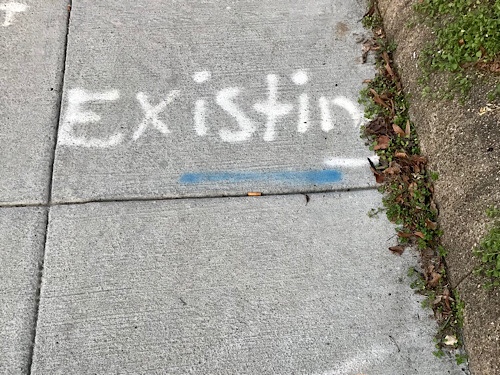
    Found Exhortation (Temporary)

    Is this to protect the line or the person who might step on or over the line? When do boundaries and rules protect and enhance life and when do they arbitrarily, inequitably, or rigidly curtail it?

    Peace and light, E — Posted with WordPress for BlackBerry.

Leave a Reply

Your email address will not be published. Required fields are marked *

This site uses Akismet to reduce spam. Learn how your comment data is processed.