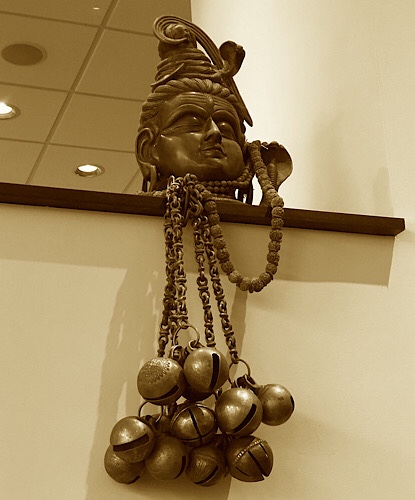
Siva and Bells


The mahabhutas are the grossest, most physical of the 36 tattvas described in Kashmir Shaivism. They are: prithivi — earth or solidity; ap (or jala) — water or liquidity, agni (or tejas) — fire or formativity; vayu — air; akasha — space. When we practice asana, we can focus our practice on discovering one of the elements in our bodies and how we move. As we get more skillful, we can choose which element seems out of balance and emphasize one or the other to bring ourselves more into balance. This week, for example, I have noticed that my mind has been scattered and distracted because of all of the excitement of the Inauguration. After being blown about by the cold and the wind and all the excitement, I had gotten to airy (which is my tendency anyway). It is a good time, therefore, to explore prithivi (earth) in my practice. By emphasizing a strong foundation coupled with the Anusara principle of muscular energy, I can literally bring myself to a more solid, stable, and grounded state.
We can work with the tattvas as described above, to realign our energies so that our physical and mental state is more balanced. We can also explore the more concrete tattvas as we embody them to understand better how they are manifestations of the subtler tattvas — the tattvas that the great yogis who have described them would call more real and we dwelling in our bodies and minds might think of as observably less real. Where we can best appreciate and experience the relationship between the gross and the subtle elements is in meditation, and our asana practice can help lead us there.
Look forward this week to working with the earth element in your bodies and minds, practicing strong standing poses and shaping your physical and energetic bodies like clay. Use your earth nature to sculpt the art of your intention.
For suggested readings see my earlier post on the tattvas.
A couple of weeks ago, I found a carved wood murti of Ganesha in a box on the sidewalk with some other stuff and a “free” sign. This Ganesha had serpents (nagas) rising over his head like a canopy–not uncommon imagery. Ganesha was “free” most likely because one of the nagas had broken off. It made me think of Ayyappa, Ganesha’s brother by a different mother. Ayyappa is apart from the others. Of Shiva’s three sons, he is the one who is either or both missing or extra. The trunk was also badly glued, but that can be remedied.

It is a gloriously cool and breezy morning of the type that is common for New England and very rare for DC, especially heading into Independence Day weekend. I had a longer and earlier walk than I usually do. I have an early morning meeting at the Internal Revenue Service.
As I walked down Constitution Avenue past the museums and federal buildings, I wondered how many of the hundreds of millions of people whose lives are impacted by the IRS ever think of it as a building with real, live human beings working inside of it.
It can be tremendously difficult to see a broader perspective when faced with things that cause us burden, obligation, or challenge. One of the key reasons to practice yoga, and in Anusara yoga to practice (it is indeed a practice we have to work on) opening to grace, is to recognize our humanity and the light in all things so that life feels more beautiful even when we are struggling.