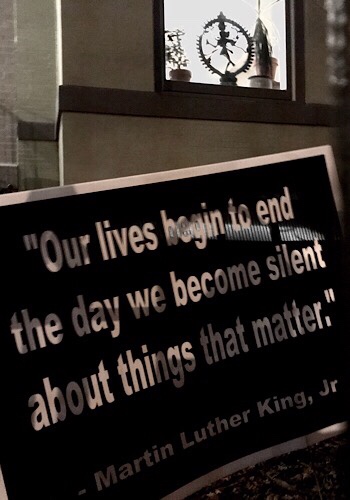
Questions on the Path (On the Way to Work)
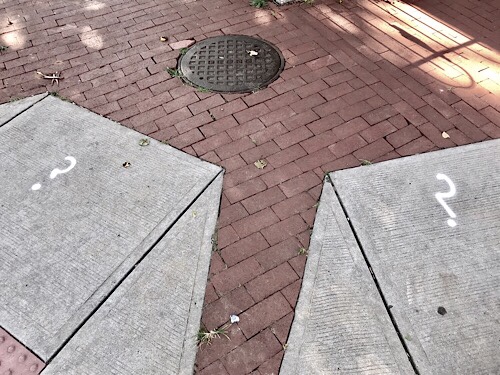
How can one be lost if one is thinking? Just asking.
Excerpt from curator’s notes at the National Gallery of Art exhibit “I Spy–Photography and the Theater of the Street, 1938-2010” (No photographs allowed).

Peace and light, E — Posted with WordPress for BlackBerry.
When I think about the Anusara alignment principles in the context of the tattvas (see earlier posts), I think about “opening to grace” appearing in two places on the tier. As “first principle” it is the first among a larger sequence about how we come to the mat, rather than just the first of the physical principles. “First principle” not only starts the practice and the dialogue, but is already there. It is, in this sense, so fundamental that it is not part of the sequence, but is sequenceless (akrama). If you are fully conscious of “grace” and can embody it in all aspects of your physical, energetic, and mental day to day existence without further instruction, study, or practice, then there is no need for other practice or instruction (this I think is a very rare being, and certainly I’m not such a being).
The next set of tattvas — suddha vidya, ishvara, saddha shiva, and shiva-shakti (see link above), correspond to the Anusara alignment principles of “attitude, alignment, and action,” which although they are themselves described in sequence, are fundamentally sequenceless as they happen all at the same time and are more elemental than the practice of the physical/energetic alignment principles in sequenced practice.
In this way of understanding the play between the sequenceless and sequenced, we have a universal “first principle” that embodies the purpose of all we do on and off the mat. It is followed by how we want to practice, described in a way that becomes less of just a concept (which as a universal concept is akrama) and more of a practical understanding (which applies when we are in space and time and therefore in the krama of embodied existence). As we dance in this play between the sequenceless and the sequenced, we come to practice (or to do any activity) with the “attitude” of wanting to live the “first principle,” to know and experience what is fully present and not bound by time and space. We then (because we must) study and practice specific “alignment” to try and express this attitude with our “actions.”
The physical/energetic alignment principles then come in as a the way of better refining, studying, and practicing the desire to recognize with mind and body the “first principle.” The sequence of “open to grace, muscular energy, inner spiral, outer spiral, organic energy” comes then at the level of physical and mental practice to return us back to “first principle.” “Open to grace” is first in this sequence, too, but as “first principle,” for me, it is something more than the first of the alignment principles. “First principle” is not just the start of how we practice when we practice Anusara yoga, but the whole reason for practice. It is the universal, overarching, blissful element of being that draws us to the practice because of our yearning to know it.
Peace and light, E — Posted with WordPress for BlackBerry.
Dear Friends,
One of the yoga practices in Patanjali’s Yoga Sutras is sauca, which means cleanliness or purity. It does have a basic aspect of physical cleanliness, which has lead me this year to do an especially vigorous spring cleaning. I think following the principle of saucra also applies to the clarity of our intention for the practice of yoga: are we seeking to experience and act from a place of deep connection to spirit (or good or oneness or divine or whatever you name it)? In practicing sauca, I think the most basic question is whether we have dust on the mirror that reflects the good in ourselves obscuring our vision, whether there are blockages to the energy flowing to bring us to optimal physical and emotional health, or whether anything is getting in the way of our manifesting our intention?
When it has been too hot to go into the garden over the past month, I have been reorganizing and sorting through old papers. As a once every five or ten years spring cleaning, it is lasting longer than usual. I tend to be good about keeping on top of these things, but there are crevises of old records of my life that seem to just get stuck back into a folder to be decided on some other time. This afternoon I came across intimate letters from a friend who, not long after we went our separate what had become cross-continental ways with regret on both sides, discovered he had brain cancer. There were a few notes not in envelopes. I reread those, but did not open the envelopes. Back into the miscellaneous file until the next time. The same with the print-outs of emails to and from Peru right after 9/11. It wasn’t avoidance. Over time and distance, regret and grief have faded. I did not have the need or the time to read them now. They went back into the file because I am curious what will be my reaction to these documents when I am 87 should I be around in this body then. I find that when I see them after again more years have passed, I can see how much the yoga (asana and meditation) as a steady practice over time has shifted how I relate to my past, to all the decisions better or worse that brought me here today. I am more at peace with the various detours and convolutions for the teachings and the good at the time, even if they do not appear to have been squarely or most efficiently on the path.
Just as most of us have pieces of paper or things that for some reason get saved, but spend most of their time in a drawer or a file cabinet or a closet, we have thoughts and emotions around past experiences that can emerge into memory at what can seem to be the oddest of times. With a strong meditation practice, it can sometimes feel like we are cleaning out the closets of our mind. With a therapeutically focused asana practice, it can seem as though we have found old energetic entanglements, and it may feel that it would have been easier never to have practiced at all. If we stay steady and keep coming to class and our own practice, we witness how much change can be wrought. When we remember to bring our clear intention to the yoga mat, the meditation cushion, the garden and the kitchen, the laundry, work and commuting and everything we do, then we in an ever more refined and deepening way open to grace, the fundamental AnusaraR principle.
I am happy to let you know that I am now E-RYT 500. My spring cleaning on the physical level motivated me to do the paperwork with Yoga Alliance. My carrying the designation E-RYT 500 means that teachers taking my classes and workshops can get Yoga Alliance continuing education credits, in addition to Anusara study hours.
I am looking forward to studying with Christina Sell at Willow Street Yoga next weekend. Come join fellow yogis for what promises to be a joyously challenging weekend of classes. The following weekend, I head up to Vermont for the Anusara Grand Gathering. If you are going, let me know and we can try to connect.
Special June Location Information for William Penn House Classes: June 14 and 28, William Penn House will be completely taken over by conference groups. Class will be held at the house location. RSVP’s are required. For those who have been regulars, but who have been full up with other things in life than class, it is a sweet way to get back.
Hope to see you soon.
Peace and light,
Elizabeth