Blossoms Around Town (and Samsara)
One of the six fundamental aspects of being (sat) in the “Shiva-Shakti” tantra that is the foundation of Anusara yoga is svatantrya — freedom. (The others are cit, ananda, spanda, purnatva, sri). Freedom in this sense is an ultimate freedom — the very cosmos is unconstrained and freely creates what we recognize as the fabric of being out of its own play (lila). We, as inseparable from being, although in some ways confined by our embodiment, are essentially free — free to choose whether to recognize our essential nature, to find bliss (ananda) in our embodiment, to recognize the fullness (purnatva) of being, and to honor the essential auspiciousness of being (sri) in ourselves and all that is around us.
In having that freedom, we can also turn away. We can stay cloaked. We can choose violence and anger rather than nurture and love. We can choose, out of our own essential freedom to remain cloaked in ignorance, to throw bricks and threaten death because of a perceived socialist tyranny because of the passage of health care “reform” that denies the right to choose, does not provide basic medical services for all (no single payor or even public option), and gives the pharmaceutical industry a pass, but does some modest regulation of insurance companies and employers. (“Better than nothing, I guess,” as one friend wrote on the internet.)
I see the t-shirt “it’s all good,” and I think, “not!” I also know that I have the freedom for myself to recognize and remember sri, to try and see it in all, including the play of freedom that includes the freedom to turn away from the light. It will be a lifetime of practice.
It is a constant dialogue that arises for me with others in my various communities about the place of political discussion in a spiritual community. Is there a place for examining the state of the world, calling for action, and trying to change things when we believe (or are seeking to understand) everything as being at its essence infused with the light? I just happened to read this parable today, after being advised that spiritual and political dialogue have no place being conjoined (today, it was about the budget and the war; it could just as easily have been about how to address from a place of spirit the complexities of how to shift and respond to the Gulf oil spill):
“RAMAKRISHNA: … [W]ater remains water, whether it stands still or breaks into waves. Divine Reality remains exactly the same when one is silent and one speaks. Relax your mind a moment and consider this parable. A guru teaches his disciple that every being and event is simply God. The ardent disciple, while walking home meditating on this truth, encounters a mad elephant. The elephant-driver, who has completely lost control of the animal, shouts to all who are in the way, warning them to run. But the stubborn disciple refuses to deviate from his path. He continues his contemplative exercise, regarding himself as God and the elephant as God. The crazed beast picks up this foolish man with its trunk and dashes him to the earth. The guru, famous for his healing powers, is called to revive the unconscious victim. After certain prayers are recited and holy water is sprinkled, the young man regains consciousness. He is surprised to find his guru gazing at him. When asked why he did not run from such evident danger, he replies: ‘Why should I run? My guru, you teach that all beings and events are God. I have implicit faith in your inspired words.’ The venerable master then addresses his immature disciple: ‘But my child, why did you fail to heed the inspired words of the elephant-driver, who is also God?'”
Lex Hixon, Great Swan: Meetings with Ramakrishna (Shambala Publications 1992)
There was nothing more
Pressing than walking about
Awed by the colors.
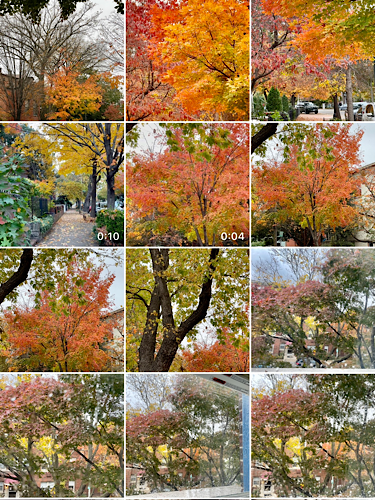

One of my favorite neighborhood trees. It had some English ivy that had started growing on the bottom. I pulled it off while getting a tree hug.
I spent a few hours this weekend reading Joseph Campbell’s Baksheesh and Brahman, which is Campbell’s journals from a year in India from 1954-55 (I’m now about a third of the way through). Campbell writes that he went to India to find Brahman and instead found politics. He approached his visit from the perspective of a mythologist. In contrast to Allen Ginsberg and the Beats, who went to India to find God, Joseph Campbell went to observe religious practices. Although the journals evidence his own perspective and prejudices, he makes cogent observations on the difference between religiosity and spirituality (not all that dissimilar to the distinctions made in the Bhagavad Gita about the difference between rigidly practicing ritual and truly believing). He also makes very interesting and still timely and cogent comparisons between the relationship of Hinduism and to the then rather new Indian nationalism and American Protestantism to democracy.
Ultimately, though, it is evident that this year was important for Campbell’s life path and work, as it was for the Beats, and has been for many of my friends who have gone, though not for all. I think about going to India. It will be when I have several weeks and don’t have a venerable and ancient cat who cannot be left behind for a long stretch of time. In the meantime, reading of such journeys can stimulate thought and can be applied to other aspects of my life, though reading and studying (especially in the yoga tradition), is never a substitute for experience. Just reading of spiritual experiences, but not doing the practices to open the door to one’s own experience is like reading cooking or gardening books, but never going into the kitchen or the garden.