| |

Ganesha’s Vahana

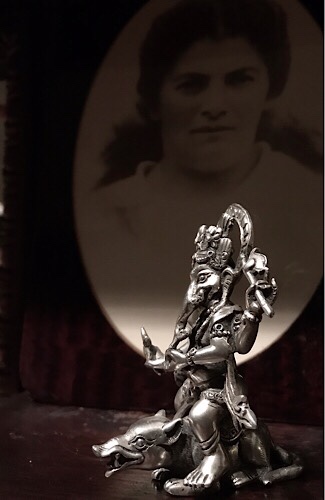
I don’t have much family, and I know little about the family I have. I am the one living with this photograph (the only one I’ve seen) of my maternal great grandmother because we are the only two with frizzy hair. The story I heard about her was that she gave birth to my grandmother en route from Eastern Europe and carried her across the ocean to the lower East Side.

This Ganesha makes me think about that level of determination –what we can do when we figure out how to turn a rat into a ride.

Similar Posts

  • A Hawk

    I saw a hawk when I was walking to work this morning.  It was in one of those stately oak trees in the park just north of the US Capitol.  I have occasionally seen hawks in the neighborhood alleys, but never one at the Capitol.  The hawk stood out for two reasons:  it was very large, and it was the only living being about.  Usually, there are a number of squirrels, pigeons, and maybe crows, sparrows, and common grackles about the park.  This morning, it was unearthly quiet; all of the other animals and birds were all in hiding.  It was probably a red-tailed hawk.  As I stood to watch this special being, a woman walked past me with her head hunched down, her hands shoved in her pockets, her briefcase weighing down her shoulder, and her face preoccupied, a common going to work look.  I called out to her, “look, a hawk.”  She was startled, maybe even a little upset at first that I had interrupted her thoughts, but then she, too, stopped and watched.  When I finally continued on to work, she stayed watching for a while, and she no longer looked preoccupied.  At the bottom of the steps of the park, I went past the police, who are there every morning with their cars parked on the sidewalk (blocking the way).  The police rarely say hello.  One of the cops, who had his dog out of the car, called out a good morning to me today, though.  I greeted him back, “good morning, did you see the hawk?”  “Yes, I’ve been watching it,” he said.  We had a nice chat about the hawk and about his being able to watch the bald eagles at Blue Fields in Virginia, where they do the training for the police dogs.

    It would have been easy for me not to see the hawk.  I use my morning walk as a time for contemplation, and when I am in the park (leaving aside the Architect of the Capitol vehicles that sometimes intrude), it is a time I can be less careful about traffic and be more inward.  But it is also a time to look and to appreciate the opportunity to be outside, whatever the weather and the season.  The trees and birds and small animals and plantings and sky look different everyday.  While I go inward on my morning walk, I am also always noticing.  This is a kind of mindfulness — to be able to be resting with inward attention, but still be open to observing whatever is in view.  Is it less mindful to be so drawn inward that the outside disappears?  That perhaps depends on whether one has deliberately gone so far inward that the outside ceases to exist for a time, which is a meditation method, or whether one is just so preoccupied with the churning of the mind that one becomes less conscious.
  • | |

    A Discussion About Pain

    The other day in group practice, someone said they wanted to work on a particular pose; another teacher had people working on staying present with pain.

    I questioned whether they should trust someone who suggested that they intentionally put themselves in a painful position and then stay there to learn to be with pain.

    I questioned whether creating and staying with pain was in any way healing.

    I questioned what they meant by pain. I think it is useful to stay with discomfort, for example staying safely with a strong posture that requires muscular and attention effort to maintain.

    But pain is an effective warning system. If the pain is sharp or abrupt or sudden or is in tendon or ligament, etc, there will be no benefit to overriding your body’s message to stop.

    Better to build strength of attention and focus and body and then apply the practices when life supplies pain that you have no choice but to remain until it heals.

  • | | | |

    More Ephemera

    Spring flowers are not much more ephemeral than are we from the perspective of infinity (or even geological time). I think one of the central aims of yoga philosophy is to make some sense of the need for recognition of our own place and worthiness, while still acknowledging our undeniable individual smallness in the vast web of being. In that light, it seeks to offer us awareness of some idea of ourselves that is infinite and not just our distinct finitude.

    Peace and light, E — Posted with WordPress for BlackBerry.

  • | | | | |

    Chanting the Names/Listening to the Silence

    Krishna Das reminding his listeners the reasons he practices and offers kirtan scrolled across my Facebook feed last week with this quote:

    “My path is to be in the living Presence; We have to find a way inside us, we have to find a way to open our hearts, to quiet our minds, to let go our fears and our selfishness, our guilt and our anger and jealousy; Everything is already present in our own hearts; By repeating these Names over and over, we are moving ourselves into that place in us; the Heart in us is deeper than any emotion or psychological issues; I don’t know if there is God, I know there is Love – Unconditional Love and I know I like to be in that love, and that maybe God; all you have to do is look, and chanting remembers us to look.”

    I am in a space right now where chanting is serving me to help remember the good, despite all that is going on that doesn’t feel particularly good or hopeful.  I don’t believe in “God” as an actual being (though I can no more disprove the actuality than anyone has been able to prove it), and history certainly proves the power of the idea of such a mystical being.

    Regardless of whether the very real ideas of God(s) represents an actual being, it has been my beautiful experience–studying with Krishna Das and others over the years–that engaging in practices that turn our hearts towards love and universality helps us be sweet living in relationship to ourselves, to others, and to the ecological fabric of the whole of embodied existence.  I chant because calling out the names in their universal multiplicity is a recognition, not dissimilar to what I have found offered in the silent collective worship of Quakers, that everyone has their own individual access to and ideas of the sublime, of the divine, of what brings them to feel a fullness of love.

Leave a Reply

Your email address will not be published. Required fields are marked *

This site uses Akismet to reduce spam. Learn how your comment data is processed.