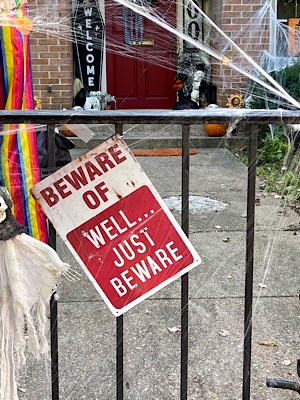
State of the Garden
I spent a couple of hours in the garden before having the honor and pleasure of going to a party to celebrate the wedding of one of the yoga practice group. It was a delightful day. I am grateful.
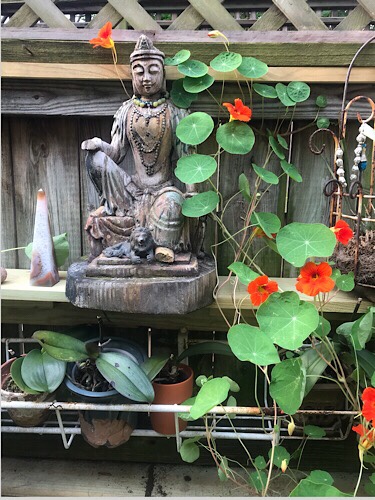
I spent a couple of hours in the garden before having the honor and pleasure of going to a party to celebrate the wedding of one of the yoga practice group. It was a delightful day. I am grateful.

Thanks to the generous Cate Stillman for this podcast. What I like most about Cate’s perspective is her teaching that truly practicing Ayurveda is paying attention at the deepest level, including paying attention to what in the classic teaching of Ayurveda work for you and what do not–being that they are imbued with cultural elements of the Indian subcontinent that do not necessarily support or resonate with our culture or individual constitutions.
As I study more, I find that it turns out that I had been practicing Ayurveda already by keeping to a regular daily and weekly routine, eating seasonally and locally, eating with sensitivity to impact on my digestion and energy level, and by having a steady practice. Not being interested in detox (more some other time on the dangers of detox) or constitution types, or arcane herbal remedies (many of these, by the way, are becoming endangered species), it turns out, does not mean having rejected Ayurveda. I do know that whether I call it Ayurveda or just plain common sense, the more I live in a balanced, sensitive, and steady way in terms of diet, sleep, entertainment, work, and consumption in general, the more I optimize my health and sense of well-being.
I have lived in my house for almost 20 years. The house came with a bottom of the line, circa 1977 Hechinger’s bathroom. The bathtub has been rusting for a over a decade, part of the faucet would come off when turning it off, etc.
Finding myself without any pets and between tenants, it seemed like a good time to renovate. Last week, in just a day, what was a bathroom, is now a gutted space. Amazing how quickly something can be rooted out and undone. It will be taking a lot longer to reconstruct.
What I am finding most challenging is not the physical chaos. I am used to it as an old house often needs work, and this house needed work (though it was not the kind of fixer-upper that was completely missing floors, electricity, and plumbing).
Rather, what I am wrestling with is my emotional reaction to the idea of having a brand new, beautiful bathroom. There is a big feeling guilty component to be spending money on something that feels not entirely necessary when so many are in need. So while the contractor is working on the construction, I am working with a wonderful opportunity to help reconstruct (post deconstructing) my emotional relationship with things. How do I find balance between honoring those in need, my impact on the planet, maintaining my house, and my enjoyment of beautiful things? How do I feel at peace with my decisions once they already have been made? How do I apply discrimination in my aesthetics to assist in this balance?
Last month, Sianna Sherman taught a weekend workshop at Willow Street Yoga. At the beginning of one of the segments of the workshop, she talked about the story of the monkey god Hanuman and his leap to Lanka (he did this to rescue Sita, who had been abducted by her own demons. Sita sent Hanuman back to India without her, asking Hanuman where was Ram, but that’s a whole different thread in the Ramayana.)
The first demon Hanuman encountered was Mainaka, a golden mountain who rose up out of the sea. She gave Hanuman a place to rest. She was helper. But she was also demon in that she wanted Hanuman to stay and rest with her and to give up his journey. Some of the stories characterize Mainaka only as a helper, and not as a demon. If Hanuman had become stuck in the comfort Mainaka offered, though, and failed in his journey, she would have been for him the demon of complacency. The question Sianna left with us to consider about Mainaka was where have we been too comfortable? Where do we need to express gratitude and appreciation, but move on?
The second demon, Surasa, was a fierce water serpent who emerged from the water to swallow Hanuman up as he was flying over the ocean. To escape, he first tried making himself so big that she Surasa could not swallow him, but she just opened her mouth wider and wider, gnashing at him with her razor-sharp teeth. Hanuman escaped by then shrinking himself to the size of a dust mote and flying out from between Surasa’s teeth. Being able to make himself immense was one of the powers he needed to be able to fight the various demons, but he needed also to be willing and able to make himself small to complete the journey. He would have been stuck if he had not been capable of taking on different shapes and approaching things from different perspectives. Surasa may have tried to swallow him up, but she also taught him perspective. “Are there places where you could use more perspective?” asked Sianna.
The third demon , Sinhaka, at least according to some versions, tried to eat Hanuman’s shadow. Inseparable from his shadow, the only way to escape was to turn back to face and claim his shadow as his own to battle Sinhaka. Running away would have just kept Sinhaka champing at his tail and dragging him back from success. We have to recognize and face our shadows in order to be complete and to understand the full spectrum of being. We were invited to ask whether there were particular fears from which we were running.
What stayed with me, and has me still thinking about the workshop, was that the emphasis was on treating ourselves and the obstacles we face on and off the mat with compassion. We often give lip service in Western tantra to seeing the good or the necessary in our demons. For example, whereas classical yoga thinks desire needs to be eradicated, tantra recognizes both that we would not get out of bed in the morning without it and that desire is what can lead us to practice and seek spiritual connection. When we can truly look at our demons (both our own personal ones and those we see in both wider and more intimate relationships), our demons are not evidently nor necessarily to be slain or eschewed or to be seen as only malignant or pestilent. When we approach our own demons and those of others with true compassion, we open the possibility of change through deeper awareness, connection, and recognition of humanity.