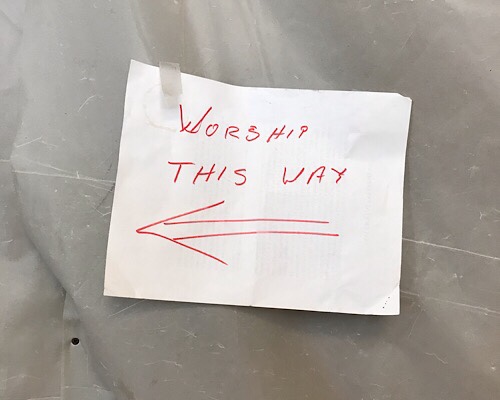
On the Way to William Penn House for Tuesday Night Yoga Practice

It’s almost time for Wednesday evening house yoga practice, and I still have my work computer on and open to a couple of documents that I need to review by Monday morning.
I try a practice from the non-violent communication course I have been taking: Since I cannot change the work situation in the short term, I am choosing to think about what needs are being met by my feeling compelled to work by the enormity of upcoming deadlines instead of getting to enjoy the two hours of administrative leave granted in honor of Thanksgiving.
I come up with this tentative list: it is good to feel needed, to be engaged, to experience a sense of competence and responsibility. As I am working from home, I get peaceful quiet and solitude while still feeling connected through the work. This does not mean that I don’t want or shouldn’t take action to change my work situation to better meet other needs, or even these needs better.
I am truly grateful that I am being brought to my yoga mat for an hour and a half tonight and that I’m looking forward to a weekend of friends and food and walks (and more work).
I wish you all the best holiday possible. May you experience gratitude.
Look forward to a longer newsletter and a new look to the website in coming weeks.
This morning I went for my bi-annual physical. The first thing that the doctor’s assistant did after having me stand on the scale (a blood-pressure elevating activity out of habit), was take my blood pressure. It was on the low end of normal, as usual for me.
In the middle of the exam, after having intimate discussions about tratment to alleviate suffering vs. treatment for longevity, and similar topics, my doctor took my blood pressure again. No surprise: it was higher than it had been when I irst walked into the exam room.
When we were just about done, my doctor said, “let’s see if we can lower that blood pressure. Close your eyes and relax.” “Relax” can be a hard command to obey. Instead, I went right to where I go in meditation, softening to my mantra. In less than a minute, my blood pressure was lower than it had been at the start of the exam. “A beauty of meditation,” I said. “Yes,” my doctor replied (who is a very traditional western medical practitioner, “I wish I could get all my patients with high blood pressure to meditate.”
Yesterday morning, before I read the article in the Washington Post I discussed in yesterday’s post, a memory of an acquaintance from Quaker youth camp entered my seated meditation. I had not thought about C in at least 30 years. He was a couple of years older than me, and all the parents were a buzz with talk and worry when C decided that instead of going to college, he wanted to give away his possessions, live in a community devoted to simple living, a vegetarian diet, daily worship, a like-minded community, and spreading what they believe is the word of God. Nowadays, many of the people who are in my broad social network would have nothing but admiration for someone who lived by and practiced such tenets, including the daily chanting of the name of Krishna (or some other deity). In the late 70s, the parents were deeply concerned: “He is in a cult, he is brainwashed, we need to get him back.” “Back to what?” I remember thinking at the time.
I have not seen a member of ISKON (International Society for Krishna Consciousness) in years. Why not? Not because the “cult” has disbanded. Rather, it has grown substantially and become part of the fabric of our global religious society. Now, by virtue of its longstanding existence, its members blend in with accepted norms of social and religious behavior.
What makes a cult? What makes a religion? How do cults and religions foster, spread, or interfere with our own relationship to spirit and our recognition of spirit in others. What is the difference between ritual and religion? Ritual and spiritual belief and practice?
ps Craig made a good point yesterday about being sensitive to the practicing Hindus when we take part in some of their practices, but not in the context of the Hindu religion. He also noted a number of rituals that have morphed and shifted with changing religious groupings in society. ISKON “took” something that was part of the Hindu religious practice and opened it to the masses (proselytizing with enthusiasm). Is that not analogous to the development of any religious sect? Think about the meaning of the word “protestant.” When is an off-shoot of a religion a cult, a “legitimate” religious group, or an offense to the group from which it parted in terms of stated belief or practice? Does it matter that some take offense? What if offense is taking because of a disturbance of a status quo that diminishes and constrains large elements of society (such as women or people of certain classes)? What about practicing a ritual to honor members of another religion — I am thinking, in this regard, of the recent example of the White House seder?
pps. How is this relevant to our yoga practice in the United States? Many of us listen to and practice our asana to the music of “chant.” Krishna Das has a CD called “All One” that has nothing on it but variations of the maha mantra “Hare Krishna” that became so notorious when ISKON was just being known here. What does it mean when we listen to such music, buy such music, share such music, chant these words?
A regular brought a friend to this week’s group house practice. When I asked whether there was anything about her health or practice I should know to enhance her experience in the class, she advised me that she had been having trouble sleeping for the past few months in response to an event in her life. I did not ask about the event, but offered some of my favorite practices when I am not easily falling asleep:
1. gentle ujayi breathing with the exhale twice the length of the inhale. We were sitting up, but this is great to do in vipariti karani (legs up the wall pose).
2. chandra bhedana (the moon breath). This is similar to nadi shodana (alternate nostril breathing) except that for every breath, the inhale is through the left (ida or chandra nostril and the exhale through the right (pinga or surya) nostril.
3. This one I learned from work place yoga teacher Kathy Rowley with whom I took lunch time classes at the Department of Labor for a couple of years. I am not sure I remember it exactly the way she taught it, but it works:
Start lying on one side. Take sixteen deep breaths, keeping count of the breaths, with the exhales longer than the inhales. Quietly roll to your other side and take another sixteen breaths. Continue switching sides, slowly and without disturbing growing sleepiness, each set of two doubling the number of breaths you take. After 16 on both sides, then 32 on both sides, then 64, and so on (though so on is unlikely). Let the breaths get slower and deeper and when you get to the point where it does not seem right to switch sides, then you let yourself sink into deep relaxed sleep.
Society generally requires one to strive for and conform to certain conventions and expectations to be recognized and rewarded by it. To connect with the magical, fortunately, does not require any particular possessions.

Peace and light, E — Posted with WordPress for BlackBerry.