| | |

When We Choose the Pleasure of the Beautiful (DWTD)

When we choose a tantric path, we choose to experience pleasure as an expression of spirit, rather than seeking to transcend such experience as would one who is on the classical renunciatory yoga path. The choice to remain engaged, to honor mind and body as divine, comes with great responsibility.

When we choose engagement, we choose to experience the divine reality not just of pleasure, but also of pain. The true tantric path does not turn a blind eye to ugliness and suffering. Just taking the pleasure without recognizing its opposite is not authentic practice. If the pleasure of the sunrise is “real,” then the garbage on the beach is just as real.

Recognizing the reality of ugliness and pain as part of the play of the real does not mean, though, that it should diminish our joy in the beautiful and in the dance of the play of opposites of life.

Rather, it is our delight in and engagement with beauty that invites us to serve as best we can to alleviate suffering, to try and clean up the garbage where we can. In other words, as we recognize that ugliness and destruction are part of the play (lila), we seek to be heart-full rather than heart-broken when we witness the suffering from violence to others or our living planet. If we let our hearts break, we become blind to the beauty. Like those who only see what brings pleasure, those who only see the painful are also not experiencing all of the real.

As I head back to the world inside the Beltway, I bring the deepened and replenished sense of beauty and the dance that I always get from collective study and practice. I will try to share the privilege of having this experience by doing my best to clean up what garbage I can, while still dancing and loving in the light.

Similar Posts

  • | | |

    Merry Christmas!

    If I have done this correctly, it is Christmas day (Boxing day for those of you who are email subscribers). If all is on schedule, I am basking in warmth (though possibly with lots of rain) witnessing ritual that in form is another world than Christmas in the cold United States. At another level, it is all one–a deep and heartfelt yearning for and an offering of love. Whatever your beliefs, whatever you are doing on this day, and however you might practice or worship, if at all, I wish you all much love, peace, and joy.

  • | | |

    Ecstatic Serenity

    When I was eight or nine, a teacher asked everyone in my class to say what they wanted to be when they grew up.  The other children named the various jobs or professions that appealed to them at the time.  I responded that I wanted to be independently wealthy.  At that age, I was expressing something I already knew from family issues.  Though I did not have the words for it or a clear understanding, what I was saying was not just false precocity.  I knew at a basic level what is taught in yoga:  I would need enough material support (ardha) to follow my heart in love (kama) and work (dharma); then my life could be free (moksha).

    When I was 22 and visiting my friend Dan, he asked me what I really wanted to do with my life.  We had just graduated from college.  Dan was working for a sculptor who was a professor in the art department; I had just moved back to New York, had just gotten over a failed attempt to serve as an office manager for an off-off Broadway theater, was in a place of deep emotional and financial struggle, and was trying to determine what work and corresponding further education I wanted.  “I want to be content,” I said.  “That’s too passive,” he replied.  “No, that’s not what I mean,” I tried to explain.  “For me being content being satisfied and engaged with my work and life, but still working hard and having goals.  It’s not just hanging out.”  I had all sorts of things that I found interesting and possibilities for a life path, but I didn’t have one specific career or life plan that I was certain would be more fulfilling than any of the others.  They just would have satisfied me in different ways.  Because of the dilemma of too many choices, I wanted to be able happy with whatever choice I made, even if it seemed like a compromise.  I was conscious that once I picked, because of the inherent limitations of time and space, that I would either have to be content with my choice or be unhappy.  I have since learned to think of contentment (samtosha), which is one of the niyamas of the path of yoga expounded by Patanjali, as a practice rather than a goal (and it is a very important and continuing practice for me).  Contentment is not an end, as I had thought when I was 22; it is just one part of the path to a goal of living liberated (jivanmukti), experiencing self as spirit in all that one does.

    On a recent telephone seminar, Paul Muller-Ortega, my meditation and philosophy teacher, in the midst of a broad dialogue regarding various studies and practices, spoke a little of ecstatic serenity.  Memories of the discussions I had had long ago about what I wanted welled up in the forefront of my thoughts.  In thinking about what is my intention now, especially with regard to my practice (sadhana), I witnessed my previously stated intentions as just stages on the path to this discovery.  As soon as I heard Paul say the phrase, I thought, “that’s what I want; I want to be ecstatically serene.”   I seek to be always in some part of my conscious being still and peaceful, while simultaneously being passionately engaged in what life brings to me and I bring to life.

  • | | |

    Atonement

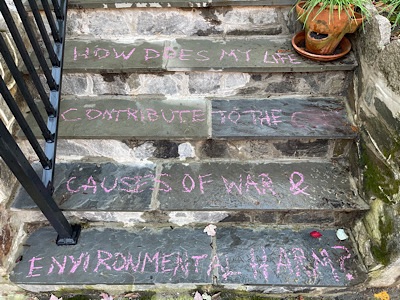
    The first question I ask myself just about every day, is how my life contributes to the causes of war and environmental harm. The the second question is what am I going to do to minimize the harm I have already caused and, by virtue of being a middle class US citizen and taxpayer with a 401(k) plan, will continue to cause as long as I remain alive?

Leave a Reply

Your email address will not be published. Required fields are marked *

This site uses Akismet to reduce spam. Learn how your comment data is processed.