|

A Dream I Won the Lottery

I dreamed last night that I won 30 million dollars in the lottery. I had no recollection of having bought a ticket (in waking life the only time I ever bought a ticket was 17 or 18 years ago as part of a 15-person group of co-workers who collectively bought two tickets when the prize was 75 million; we were going to quit en masse if we won).

In the dream, an acquaintance also won the same amount. She immediately quit her job and started engaging in activities about which she had previously only imagined doing.

On learning of my windfall, I stopped and paused and found that I didn’t want too much change right away. I deliberated about whether to take a lump sum or an annuity and to whom I would give the money. I wondered whether I could take a couple of months leave and then go back to my job part-time. I thought about whether I would like to move or set up a charitable foundation or teach yoga full-time. I found that after having been given financial freedom, I was still content to work and to live comfortably, but relatively modestly. I wanted to take time to deliberate where I could make the best offering with this outrageous stroke of luck.

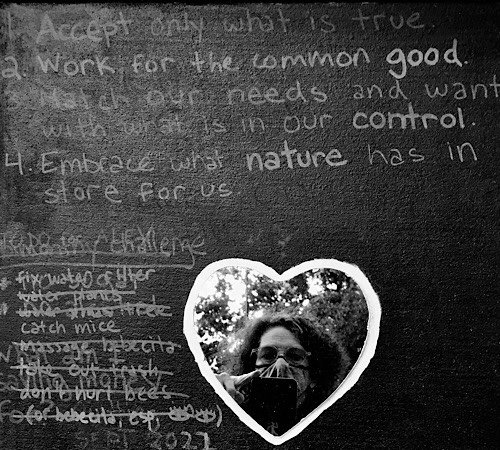
The dream reminded me of the Zen proverb that was popularized in the 1970s: “Before enlightenment; chop wood, carry water; after enlightenment; chop wood, carry water.” What was beautiful about my dream was a sense of a deep acceptance, a sense that even with my desire to grow and change for the better, that in my middle age, I am essentially comfortable with how I am living. I will keep seeking a deeper and more loving and compassionate way of being, even as I recognize that there is no prize that will transform me from the challenges of being human.


Similar Posts

  • | |

    Worrying (and the kanchukas)

    This morning, woken by the purring cat from an anxious dream in which I was not doing enough to make things better (I am not making this up), my first thoughts were of escalating war in Afghanistan and deepening economic crisis at home.  It felt almost strange and abstract to be worrying about these things from my warm comfortable bed.

    I think worrying can have a positive place in our lives.  If we just get worried or anxious about things and get trapped in not doing or growing or reaching (both inward and outward) for a sense of connection and spirit, then worrying will cloak or limit us.  If we recognize worries as showing us limitations, then we can use them to grow and change and spur us to action.

    After the 25 tattvas describing the physical world and our being and understanding of the world that correspond in both the classical and Kashmir Shaivist systems, are Kashmir Shaivism’s six kanchukas — cloakings or coverings.  The kanchukas are niyati (limitation of place), kaala (limitation of time), raaga ( attachment), vidya (limitation of knowledge), kalaa (limitation of action), maya (illusion of individuality/manifestation).

    From a tantric perspective, experiencing ourselves as thinking, individual beings in the manifest world, constrained by time and space, only binds us if we think that is all we are.  If we get completely entangled in these constraints, then our sense of spirit is cloaked, just as if we get stuck in worrying, instead of using worries as a spur to work for change, we become miserable.

    I meditate and practice asana, as taught by my teachers, to reveal the restraints of physical being as only part of my being.  Spiritual practice can serve to enable us to experience freedom of heart and mind, to bathe in the bliss of the essence of ourselves that is universal and unconstrained by the limitations of individual manifestation.  The point of these practices not to escape our individual selves or to gratify them (that would still be “cloaked”), but to find the strength and stability to serve better and to work for a world in which all beings have an equal chance to seek the spirit and experience the bliss of connection.

  • | |

    Found Exhortation (With Caveats)

    loveThe ubiquitous exhortation to love that we find in so many spiritual teachings does not, I think, require us to love the individual as an individual.  Loving an individual particularly requires liking, and liking is an idiosyncratic thing and as with all tendencies and preferences is much out of our control, even though acquirable to some extent.  The love exhorted as a spiritual practice and aim to be possible must be that of the universal, of what is common, even if the only thing that is in common is the fact of being.

    dusk

  • |

    One Love

    There are several heart-shaped holes in the sidewalks on my usual haunts. A number have gotten progressively more heart-shaped over a period of months. Who are the good fairies who are chipping away at things to remind us of the heart if we are just paying attention?

  • | | |

    How Do You React? (and Dharma)

    How do you react when you see signs of neglect, disinterest, disregard for the health and well-being of the earth and other beings?  Do you get stuck in a sense of helplessness or rage? Do you think we’re all screwed anyway and decide no effort to make things better is worth it?  Are you moved to political action?  Are you moved to take better care of self, family, and friends, even if you think you cannot make much of a greater impact beyond your intimate circle? Can you remain engaged and still find joy, whatever the apparent immediate results and how hard the battle seems to be?

    The Bhagavad Gita, says that to live a life of yoga, we must do the last of these.  The first teaching from the Bhagavad Gita on this point is that we must live in accordance with our  dharma (duty).  The second teaching, and more important for having peace of mind in a life of duty, is that of “actionless action.”  The true yoga is to live a life of action in accordance with dharma, but without attachment to the outcome (i.e., live in an orderly way, accepting the tendency of the universe to be chaotic). 

    Dharma in the Bhagavad Gita, of course, contemplated rigid roles in terms of livelihood and place in society.  In the paradigm of citizenship in a democracy that does not so narrowly circumscribe one’s livelihood or place in society, I wcould argue that it is all of our dharma to participate as a citizen, voting, speaking out for our beliefs, and otherwise using the freedom we have to live a life that best supports the twins of individual and common good, including not just human good, but the whole ecology in which we exist.  The actionless action part is to keep seeking (without despairing) to make things more in alignment even if the forces against healing, nurture, and alignment seem to conspire against positive results that we will see or actualize ourselves.

    Are you registered to vote?  Have you watered your trees?  Casey Trees reminds us that this week in DC is dry; trees need about 25 gallons of water or 1 1/2 inches.

One Comment

Leave a Reply

Your email address will not be published. Required fields are marked *

This site uses Akismet to reduce spam. Learn how your comment data is processed.