Vegan Cranberry Walnut Oatbran Muffins

At what point does a recipe cease to be the one from the book and become one’s own?  These muffins are loosely based on Martha Rose Shulman’s “Overnight Bran Muffins” from her book Great Breads. Her ingredients are:  raisins, bran, boiling water, eggs, sunflower oil or melted butter, honey, molasses, buttermilk, whole wheat flour, white flour, baking soda, and salt.  She bakes hers at 400F for 20-30 minutes.  If I had just replaced the raisins with cranberries (sometimes I use other berries or dried fruits), or replaced the buttermilk with soy milk or juice, or used all whole wheat flour instead of a mixture of whole wheat and white flour, and added a few spices, it would not have been my cooking.  But when one changes nearly every aspect of a recipe, is it a new recipe?  I just happened to start with this one, but I could just have easily started modifying the recipe on the back of the bag of cranberries for cranberry bread or any one of a number of the recipes I have for apple, cranberry, or bran muffins and came to the same place.

I used chopped cranberries, succanat, walnuts, oat bran, egg replacer, walnut oil, soy milk, ground flax seed meal, whole wheat pastry flour, cinnamon, allspice, baking soda, and salt and changed some of the proportions, the order in which I prepare and mix some of the ingredients, and the baking temperature and time.  Ms. Shulman’s muffins are richer and more classic for having the eggs, buttermilk, and white flower, but the ones I made this morning tasted pretty good, and I recommend her book as an excellent place to find solid, easy to follow recipes.  I honor her recipe as a starting point, the way I honor my teachers on the yoga path, but still bring in my own experience.

Want to make your own?

  • Take a cup of cranberries (these are the last of the cranberries I bought last fall and then froze to use through the winter; you might not be able to find cranberries this time of year, so use whatever you have on hand), chop them in a wooden bowl, toss with a few spoonfuls of succanat (dried fruits or sweeter berries do not ask for the extra sugar) and set aside.
  • Wisk together in a large bowl egg replacer (one egg’s worth), 1/4 cup walnut oil, and 1/4 to 1/3 cup maple syrup (or other liquid sweetener, including fruit juice concentrate).  Soften 1 cup oat bran with about 7/8 cup boiling water.   Mix oat bran into liquid ingredients.
  • In a separate bowl, mix together 1 cup whole wheat pastry flour, 1/2 cup ground flax seed meal, a pinch of salt, and a slightly rounded teaspoon of baking soda.
  • Quickly fold the dry ingredients into the wet without over mixing.  Add the cranberries and then the walnuts.  Bake at 350-360 for 18-24 minutes in lightly oiled muffin tins.  Makes 12.
  • Modify to your delight.  If you are allergic to nuts, skip the walnuts and use safflower or canola oil instead of walnut oil.  Go to Ms. Shulman’s recipe as a starting point and create your own.

I freeze muffins and then take one to work (I transport muffins wrapped in a cloth napkin or a reused bag from nuts or dried fruit)  instead of buying coffee shop muffins.  Saves on packaging, calories, and I know it was made with love.  Keep the coffee store pastries for a special treat or for when you’ve temporarily run out of your own.

Similar Posts

  • | | |

    World Wide Knit in Public Day (and Vikalpa Samskara)

    World Wide Knit in Public Day is this weekend — June 13th (and 14, 20, and 21).  What will you be knitting?  I have started a pair of leg-warmers.  The pattern was really for ankle warmers, but I have chosen to make them longer than the pattern suggested.  The nice farmers who raise the sheep, spin and dye the yarn, and sell it at the Dupont Fresh Farm Market, called them “yoga socks.”  The yarn is beautiful.  The sample pair looked like something I would want on my feet in colder weather.  The project was small enough to tuck into my carry bag.  Definitely a go for summer knitting (unlike the three-quarter finished mohair shruggy that has become a lapful of furry stuff).

    “Why are they so short?” I asked.  “We had originally designed them to be longer, but our teacher said we might need to grab our ankles?” they explained.  “When would you do that, when it would not matter whether you were touching fabric instead of your skin,” I puzzled out loud, not out of criticism, but really wanting to know, thinking maybe in Pilates.  The farmers could not really think of a reason.  I bought an extra skein along with the kit to make the — oh, let’s call them footless socks — calf height.  The yarn has a bit of a stickiness to it, so they are not slippery.  They will be good to wear for yoga.

    I’ve never knitted on double-pointed, size 2 needles, in the round before, though I happened to have four in the house (picked up at a yard sale for a $1 a decade or two ago and put in the sewing box).  I tend not to knit from patterns for whole projects.  So I had a little learning to do.  The pattern did not explain how to use the double-pointed needles; that knowledge was assumed.  I am not used to the contraints of following a pattern.  Doing so, on occasion, though, forces me to learn a new technique.  It took my a couple of hours to get into the rhythm, but now I’ve eased into the project.

    I sometimes seek the same type expansion with cooking.  Though easily able to cook something delicious without a recipe with most ingredients, sometimes I pick out a complicated recipe just to expand my skills in the kitchen.

    Yoga, most of all, benefits from a combination of free exploration and attentive development to the knowledge imparted by a teacher.  We are most full and expanded when we combine experience and teachings.  We receive the teachings and then we practice again and again to make it not just our own experience, but part of our being.  This process is called vikalpa samskara.

  • |

    State of the Garden

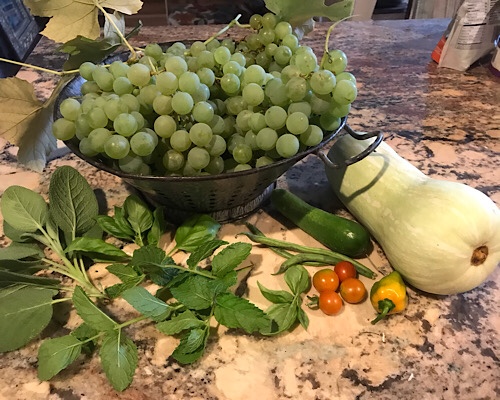
    After almost none all summer, now they’re ripening in abundance. I’ll roast and then freeze most of them to eat in the winter.

    I attended yoga class by zoom this afternoon. We worked on the poses that benefit from attention to engaging the major muscle groups of the trunk. And we thought about acting from our center, and finding center so we can better act.

  • | |

    Some Books on Food I’ve Been Revisiting (Yoga of Eating Part II)

    I have been revisiting these cooking and gardening books from among my varied collection as I prepare for the “Yoga of Eating” Workshop.  In addition to having recipes and/or gardening techniques each teaches about health, ecology, plants, and seasonal eating, is written in a way that would appeal to both novice and expert cook/gardener alike (including some recipes in the gardening books), and some have very pretty pictures.  The key words for this focus in the titles:  enjoyment, art, healthy, ecological, seasonal, healthy, earth, practical — essential attributes/attitudes/directions for eating with yoga consciousness.

    Cookbooks:

    Bishop, Jack, A Year in a Vegetarian Kitchen:  Easy Seasonal Dishes for Friends and Family (Houghton Mifflin2004)

    Sass, Lorna, Recipes from an Ecological Kitchen, Healthy Meals for You and the Planet (Wm. Morrow & Co. 1992)

    Shaw, Diana, The Essential Vegetarian Cookbook (Clarkson Potter 1997) (Your Guide to the Best Foods on Earth:  What to Eat; Where to Get It; How to Prepare It)

    Tiwari, Maya, Ayurveda:  A Life of Balance (Healing Arts Press 1995) (The Complete Guide to Ayurvedic Nutrition and Body Types with Recipes)

    Waters, Alice, Chez Panisse Vegetables (Harper Collins 1996)

    Kitchen Gardening:

    Bremner, Lesley, The Complete Book of Herbs:  A Practical Guide to Growing and Using Herbs (Dorling Kindersley – London 6th Ed. 1993)

    Gilberti, Sal, Kitchen Herbs:  The Art and Enjoyment of Growing Herbs and Cooking with Them (Bantam 1988)

    Guerra, Michael, The Edible Container Garden, Growing Fresh Food in Small Spaces (Fireside 2000)

    Lloyd, Christoper, Gardener Cook (Willow Creek Press 1997)

    Pavord, Anna, The New Kitchen Garden (Dorling Kindersley Am. Ed. 1996) (A Complete Practical Guide to Designing, Planing, and Cultivating a Decorative and Productive Garden)

  • | |

    State of the Garden

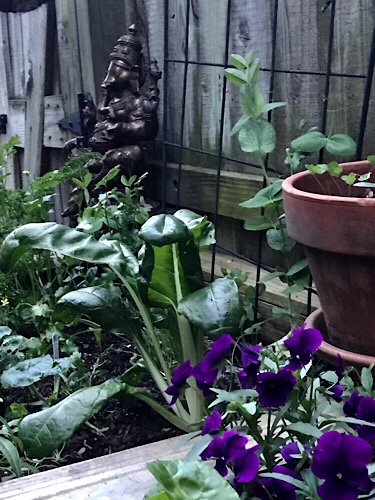
    The grapes are starting to bunch, and for the first time, the kiwi is covered with buds.  Two of the tomato plants have their first flowers.  Snow peas are climbing up the trellises.  Carrots, spring onions, radishes, and beans are sprouting.  There are plenty of cool weather greens and herbs for eating already.  The red roses are blooming.  I pray for sufficient rain.

Leave a Reply

Your email address will not be published. Required fields are marked *

This site uses Akismet to reduce spam. Learn how your comment data is processed.