An Interface with India We Don’t Think About Much
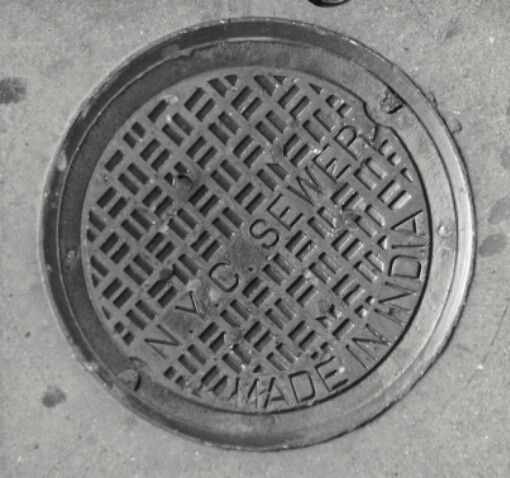
Beautiful manhole covers.
Beautiful manhole covers.
I have a set of cards that I keep on my altar that are designed to be used for contemplation. There are about fifty cards, each of which has a sanskrit word and its meaning. Just as one gets a fortune cookie randomly or picks a tarot card from a deck, but the message often seems right on point, the word that arises from the card picked from the stack often seems uncannily timely. Early Saturday morning, after not having used the cards in a few months, I picked a card from the middle of the stack to see if it would help guide my contemplation and meditations as I was getting ready to say good-bye to Becky. The word on the card I picked blind from the middle of the stack was “moksha” or liberation. In classical yoga, moksha does carry with it the implication of being liberated by transcending body and mind.
Later on Saturday, when I was on my way home from teaching for the appointment with the vet, I stopped at the metaphysical supply shop for a piece of rose quartz (to use in a ritual to assist with the transition and loss that a friend taught me). At the check out were “dolphin saying cards.” There was a sign next to the cards inviting customers to take one for free. The sign also said that it was not necessary to take the one at the top. The cards were face down; I did not look for a particular saying. I dug a few cards down, and the one I selected read: “freedom has its roots within yourself.” In other words, “moksha” for the second time on this day, when I was facing with Becky her transition of the spirit from the body.
Was it a message? Was it a coincidence? I do know that I knew when it was time, as I did with Henrietta. Becky just did not want to be embodied anymore. When I held her in her arms after she stopped breathing, she was released and relaxed in a way she had not been in months. That the signs were saying “moksha” resonated with Becky’s power and connectedness. I hope that when I am ready to go, I will truly understand moksha, that I will be released. It is so resonant of Becky’s life, for all her quirks, that she was still teaching me even as she was dying.
Fostering community and joy is also part of the resilient resistance.
Peace and light, E — Posted with WordPress for BlackBerry.
It started before yesterday’s Tuesday night class. There was a piece of fuzz next to one of the students mats–a schmutz. We then decided that the yoga outfit, especially the old raggedy one, was a schmata. Tonight, I was in an uncharacteristically silly mood. With birds falling out of the sky, fish washing up on the shore, and the Republicans taking back “control” of the house, I could weep or I could find the laughter in small things. Tonight, with a practice theme of the Anusara’s “first principle” — opening to grace — I spontaneously and giddily came to the latter.
I mentioned the idea of yiddish for yogis, and the class took off. We were all women tonight, so it was “yoga for yentas.” The word one utters when going into the first forward bend of the practice, is of course, oy, which can be lengthened to oy vey is mir. When we are truly opening to grace, we are kvelling; when we are noticing our aches and pains and forgetting to move towards the good, we are then kvetching.
Just FYI, I learned after doing a cautious internet search before posting this blog entry, that it turns out that the phrase “Yiddish Yoga” has been trademarked. I am pretty certain we can still have fun talking about using yiddish vocabulary words in yoga class without violating any laws, though it has been over 20 years since I took class in copyright and trademark law. So feel free to think of your favorite yiddish word and how it should be used in yoga class. You never know how it will enhance your practice, for whom it will bring a smile or a laugh, and what other thoughts might arise. I’m pretty sure that there isn’t a yiddish equivalent for satcitananda, any more than there is an English equivalent for weltanschauung or schadenfreude, or a French word for sandwich, but at least one student wants to give it a try.
My friend J.E. forwarded this email from her friend Kathy O., inviting me to share this with every woman I know. This remembrance felt in kindred spirit with my honoring the Day of the Dead.
This is the story of our Mothers and Grandmothers who lived only 90 years ago.
Remember, it was not until 1920 that women were granted the right to go to the polls and vote.
The women were innocent and defenseless, but they were jailed nonetheless for picketing the White House, carrying signs asking for the vote.And by the end of the night, they were barely alive. Forty prison guards wielding clubs and their warden’s blessing went on a rampage against the 33 women wrongly convicted of ‘obstructing
sidewalk traffic.’
(Lucy Burns)
They beat Lucy Burns, chained her hands to the cell bars above her head and left her hanging for the night, bleeding and gasping for air.
(Dora Lewis)
They hurled Dora Lewis into a dark cell, smashed her head against an iron bed and knocked her out cold. Her cellmate, Alice Cosu, thought Lewis was dead and suffered a heart attack. Additional affidavits describe the guards grabbing, dragging, beating, choking, slamming, pinching, twisting and kicking the women.Thus unfolded the ‘Night of Terror’ on Nov. 15, 1917, when the warden at the Occoquan Workhouse in Virginia ordered his guards to teach a lesson to the suffragists imprisoned there because they dared to picket Woodrow Wilson’s White House for the right to vote. For weeks, the women’s only water came from an open pail. Their food–all of it colorless slop–was infested with worms.
(Alice Paul)
When one of the leaders, Alice Paul, embarked on a hunger strike, they tied her to a chair, forced a tube down her throat and poured liquid into her until she vomited. She was tortured like this for weeks until word was smuggled out to the press.
http://memory.loc.gov/ammem/collections/suffrage/nwp/prisoners.pdf<http://memory.loc.gov/ammem/collections/suffrage/nwp/prisoners.pdf>So, refresh my memory. Some women won’t vote this year because — -why, exactly? We have carpool duties? We have to get to work? Our vote doesn’t matter? It’s raining?
(Mrs. Pauline Adams in the prison garb she wore while serving a sixty-day sentence.)
Last week, I went to a sparsely attended screening of HBO’s new movie ‘Iron Jawed Angels.’ It is a graphic depiction of the battle these women waged so that I could pull the curtain at the polling booth and have my say. I am ashamed to say I needed the reminder.
(Miss Edith Ainge, of Jamestown , New York )
All these years later, voter registration is still my passion. But the actual act of voting had become less personal for me, more rote. Frankly, voting often felt more like an obligation than a privilege. Sometimes it was inconvenient.
(Berthe Arnold, CSU graduate)
My friend Wendy, who is my age and studied women’s history, saw the HBO movie, too. When she stopped by my desk to talk about it, she looked angry. She was–with herself. ‘One thought kept coming back to me as I watched that movie,’ she said. ‘What would those women think of the way I use, or don’t use, my right to vote? All of us take it for granted now, not just younger women, but those of us who did seek to learn.’ The right to vote, she said, had become valuable to her ‘all over again.’HBO released the movie on video and DVD . I wish all history, social studies and government teachers would include the movie in their curriculum. I want it shown on Bunco night, too, and anywhere else women gather. I realize this isn’t our usual idea of
socializing, but we are not voting in the numbers that we should be, and I think a little shock therapy is in order.
(Conferring over ratification [of the 19th Amendment to the U.S. Constitution] at [National Woman’s Party]
headquarters, Jackson Pl [ace] [ Washington , D.C. ]. L-R Mrs. Lawrence Lewis, Mrs. Abby Scott Baker, Anita Pollitzer, Alice Paul, Florence Boeckel, Mabel Vernon (standing, right))
It is jarring to watch Woodrow Wilson and his cronies try to persuade a psychiatrist to declare Alice Paul insane so that she could be permanently institutionalized. And it is inspiring to watch the doctor refuse. Alice Paul was strong, he said, and brave. That didn’t make her crazy. The doctor admonished the men: ‘Courage in women is often mistaken for insanity.’
Please, if you are so inclined, pass this on to all the women you know. We need to get out and vote and use this right that was fought so hard for by these very courageous women. Whether you vote democratic, republican or independent party – remember to vote.
(Helena Hill Weed, Norwalk , Conn. Serving 3 day sentence in D.C. prison for carrying banner, ‘Governments derive their just powers from the consent of the governed.’)
History is being made.
So, refresh my memory again. Some women won’t vote this year because – why, exactly?
It is an affirmation that my life suits me, when I am happy to be home (even working) after a spectacular vacation.