| | |

State of the Garden

I think during World War II, backyard gardens supplied something on the order of 40 percent (don’t quote me on this) of the nation’s produce. Were we to do that, how much it might contribute to alleviating any shortages–with so much of our food from beyond closing borders.

How might it help shift our growing climate imbalance and social inequality and the hideous chaos it unleashes? Wouldn’t growing some of your own food be a healthy strategy?

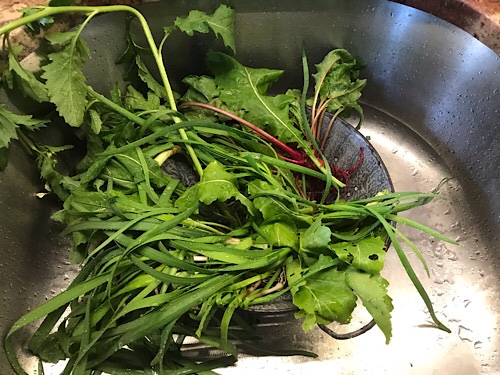
The generous harvest from today’s garden all came up from prior year plantings. I may joke about how many variations of greens and grains and pulses I can come up with, but the greens are from my back garden, bursting with nutrients, and everything else is a long storage pantry item (including in recent years, dried beans, for having grown enough of them). Most anything else is a luxury. I can go a long time between trips to the grocery store and still have well-flavored, healthy, and inexpensive meals.

Similar Posts

  • | | |

    Comfort Food Potluck Red Cabbage and Sprout Salad

    Last night I went to my neighbors’ “comfort food pot luck.” Comfort food tends to mean for many of us in winter warm, dense, heavy, rich food that is likely to be white, beige, or otherwise pale in color. There is much to be said for the emotional impact of great mashed potatoes or macaroni and cheese, especially when it is cold.

    As I was deciding what to bring and remembering that last time I went to this pot luck there were three kinds of macaroni and cheese, mashed potatoes, and multiple kinds of bread, I thought about what would bring me comfort in that context.

    My diet is not subject to any particular label. I mostly do not eat meat or cow dairy–perhaps vegetarian/vegan preferred would be a good label to the extent one would need to give a label (we are so fond of those in this society). I also prefer local and organic food, in that order, when available, and find my health benefits from a fair percentage of my diet being raw, fresh fruit and vegetables.

    Based on my assumptions of what others would likely bring, I thought that it would give me great comfort to have something fresh, bright, crunchy, raw, organic, and mostly local to go with mashed potatoes (they were delicious Marlene) and assorted casseroles. I took a look at what was in the kitchen and found I had red cabbage, a couple of apples, an onion, and some carrots from the farmers’ market; organic celery, raisins, ginger, lemon, apple cider vinegar, and white miso from the food coop and the organic grocery store; and mung beans sprouting on the counter.

    The red cabbage salad and sprout salad was a hit as a foil for the traditional “comfort food.”

    Since you asked, here’s how its made:

    Mince some onion and dice a small red cabbage. Splash some apple cider over the onion and cabbage so it can start pickling while you are cutting up the rest of the ingredients.

    Dice some carrots and celery and add to the cabbage and onions.

    Throw in some raisins.

    Mince some ginger and add to vegetables.

    Mix a couple of tablespoons of mild white/blonde miso and some Dijon mustard to taste (a darker miso will be too strong) and stir in hot water to thin until the miso-mustard mix is a creamy consistency and stir into the vegetables.

    Dice an apple or two and mix in with the other ingredients.

    Add some fresh bean sprouts if you have them (I always have sprouts growing except in the hottest weather; a good source for supplies is www.sproutpeople.org; best to add the sprouts while they are still short so they are the same texture and size of the other ingredients in this chopped salad).

    Squeeze in some lemon juice to taste (or more vinegar if you don’t have a lemon on hand or want to be completely local). If necessary to get the dressing spread evenly over the vegetables, add a little more water.

    Add another apple or additional raisins if you need more sweetness to offset the saltiness of the miso and the astringency of the vinegar and lemon juice.

    This salad benefits from sitting for at least a few hours. It can sit overnight without the apples and the sprouts–the miso starts to ferment the cabbage as for sauerkraut, which is nice– but the apples and sprouts will get mushy and are better added at the end.

    Enjoy. Play with ingredients and quantities and please comment if you come up with a delightful variation.

  • | | |

    State of the Garden (First Weekend After the Fall Equinox)

    I pulled no longer productive summer plants and planted lettuce, spinach, chard, and arugula. The birds have been eating my seeds, so I got seedlings at Eastern Market yesterday morning.  I have planted some more seeds, but wanted back up.  The grape tomato is still prolific, alone among the tomatoes.  The cucumbers are completely past, making room for chard and turnips.  It is time to make the last batches of pesto with the basil and parsley.  Another blossom has come and not quite gone on the night-blooming cereus.

  • | | | |

    “You Who Choose to Lead Must Follow,” Argentinian Tango, and the Dance of Shiva and Shakti

    On Friday night, Professor Douglas Brooks offered a satsang that was hosted by District Kula. One of the attendees, who said that she did no yoga, but taught Argentinian tango, wanted to know about what she had heard of yoga talking about the dance of masculine and feminine because that’s what tango is all about.

    Douglas gave a quick overview of the idea of the tattvas as a foundation for an answer to the tango dancer’s question. As part of this background, he discussed the numerological aspect of the tattvas, saying that Shiva and Shakti relate like this:  one is two becomes three becomes five. The two must separate, and the space between them makes three and teaches us the one.  Because of the spaces between, we do not have one to two to four, but two (one because inseparable) to three to five.  We know the one only when we know two, and the one is therefore part of three.   (“Lovely dance of numbers; that makes perfect sense,” I thought, having a happy geekfest in my own mind.  “I’ll enjoy pondering how that might be an explanation for there being five top tattvas and not six or four and wondering whether I had even begun finding an understanding, even though what Douglas was talking about is something I have been contemplating for years in various ways and contexts.)

    Douglas then led into a description of the inseparable, inextricably intertwined nature of Shiva and Shakti.  “It is like that in tango,” the dancer interjected at multiple points.  “The better the leader, the more he is listening to the follower, thus allowing the follower to be the leader.”  Each time Douglas refined his response, the dancer offered something else about her experience with tango.  “Right, when they are dancing well, the man takes on some of the characteristics of the feminine, and the woman that of the man.  The difference between them starts to dissolve into the dance itself.”  Her eyes lit up, and she bubbled up with speech, in her excitement at finding in the tantric philosophy what appeared to be an explanation of what she experiences in the tango.

    The tango dancer and the yoga texts assign specific roles and attributes to the masculine and the feminine, and we tend to fall into that tradition when we discuss the tantric philosophy.  As much as the traditional tantrika or tango dancer might say that the masculine and feminine (when embodied) take on/have characteristics of each other, they have assigned masculine/feminine roles to play, and they are still stuck in a paradigm that keeps real humans in assigned roles.  These assigned roles impact how male and female are permitted to act in society, regardless of any recognition that who is actually, rather than technically, in charge may be in flux on different levels.

    The paradigm of tango dancing kept Friday night’s discussion within the context of typical and rigid roles for male and female, but I do not think that is a required way for us to think of how to bring the tantric yoga philosophy into our lives.  When we think of the tattvas as abstract principles, we do not have to privilege in our lives or own thinking the traditional divide between male and female roles as the basis for understanding the play of opposites (though to be true to the text in its historical context we do).

    I believe that the dance of shiva and shakti is as much about the dance between the universal and multiplicitous individuality as it is about the specific play between masculine and feminine in assigned roles.  The one is two.  The two (one) separates into three; when the two separate we discover the one (two), and after that the three becomes five.  I remember a friend saying in our college days, “There are three of us in it:  there is me, there is my loved one, and then there is our relationship.”  To be in the world and relate fully, the tattvas (and dances with partners of either sex) teach us that two are inseparable by being in relationship.  By recognizing the appearance of separation, the dance of Shiva and Shakti tattvas shows us the relationship — the oneness.  Thus, all consciousness is one, but two, and then three, and yet still one.

    How this informs me, other than enjoyable thoughts in my head, is that when we try to be spaciously and openly aware in all of our relationships of this elemental play of individual identity, separability, and indivisible unity, we see the other in ourselves and ourselves in the other.   This helps much to inspire friendliness, understanding, and compassion.  It also helps bring understanding of the leader when we are following, which it makes it easier to follow with discrimination, but without judgment.  When it is our turn to lead, it helps us know that for those who might choose to or be required to follow us for some particular project, that to lead well we must listen to the followers.  As the the Grateful Dead taught me decades ago, “you who choose to lead must follow.”

Leave a Reply

Your email address will not be published. Required fields are marked *

This site uses Akismet to reduce spam. Learn how your comment data is processed.