Dogwood (and the Five Acts of Shiva)
Tight buds of next Spring’s
Flowers amid reddening
Leaves about to fall.

Note: The five acts of Shiva are concealment, revelation, creation, sustenance, and dissolution
Tight buds of next Spring’s
Flowers amid reddening
Leaves about to fall.
Note: The five acts of Shiva are concealment, revelation, creation, sustenance, and dissolution
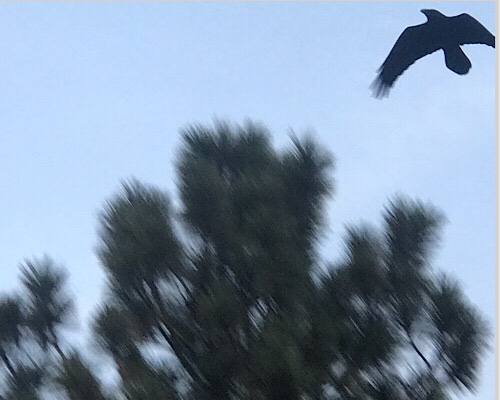
Wind-rustled feathers
Of a raven taking flight
On my silent walk.
Last night, Paul Muller-Ortega, as part of the introductory talk for the meditation intensive, spoke at some length about the principles of ardha, kama, dharma, moksha.
As I have written about before, in the classical yoga view, it is the renunciation of the first three–material well-being, love and relationship, and right work or path, that leads us to the fourth–liberation. From a tantric yoga perspective, it is living and having the first three from the perspective of illuminated wisdom and discerning (viveka) insight (pratibha) that makes us free (jivanmukti) in this life.
One of the most exquisite things about a steady practice and study, is that each time we revisit a core concept, we hear and understand new aspects to bring into our lives.
When speaking of approaching these elemental aspects of human being, Paul noted that ardha includes not only material well-being, even wealth, but also the power that wealth brings and how we use it. Although he only mentioned that briefly amidst several other concepts, it really resonated with the current state of my being in relationship to the world and our country.
I have been contemplating deeply about wealth and power in this time of budget debate, and how they can and should be used to bring nurture, peace, and health to the maximum degree possible. (You might guess that I don’t think increasing spending for war and decreasing spending for education and health is going to bring us freedom).
Thinking about the power of money as part of our contemplation of our material well-being is something of critical importance at this time. If we shun or disdain in our minds wealth and power while still yearning for our own comforts, than we have lost an opportunity to bring the yoga principles into our lives as optimally as possible. (Of course, grasping and coveting money and power is completely destructive of the possibility of happiness, but most of us think about that, and it is why some say they are bad — money being the root of all evil, etc.).
If we are really in the world and want to be happy and to share and spread happiness, while living in accordance with the principles of the yamas and niyamas, especially the yamas: ahimsa, satya, aparigraha, brahmacharya, asteya (non-harming, truthfulness, non-greediness, aligning with spirit, and non-stealing), that is when we will start opening up the possibility of true living liberation.
Imagine, instead of thinking about material well-being as a “guilty pleasure” thinking of ways in which you can use your own well-being (and work through your practice to discover greater health and strength) to be a voice and power for good in your own individual way.
Peace and light, E — Posted with WordPress for BlackBerry.
One of these days, I intend to add some words, along with the pictures. I’ve been practicing and studying, and integrating and, public health permitting, would like to start offering more regular practices.
Vinyasa krama is the art of sequencing. How a yoga practice or flow is sequenced can determine whether it is uplifting or inward going, exhilarating or calming. When we are trained and attentive, we start to know the most optimal order to open our bodies and our focus to align with the time of day, the season, the weather, our mood, and our health. This incredible art helps us be positioned and aligned in a way that we feel free in time and space, rather than being constrained by time and space.
This morning while I was out in the garden, I was thinking a lot about vinyasa krama and the goddess Kali — goddess of, among other things, time and change, and thus, of sequencing. I woke very early, brought to consciousness by the long light of the solstice even through closed curtains. As I went about my morning, rinsing the sprouts while heating the water for my morning coffee; cutting back the greens and herbs before starting breakfast; doing the major pruning and clean-up before doing more decorative garden work; finishing cooking before taking out the recycling; applying a facial mask before starting to vacuum; never walking up or down the stairs empty-handed; waiting to gather the bills until after I was clean and waiting for friends to arrive, etc., I realized how important sequencing is to the richness of my days. By knowing the best way to order tasks for my needs, my day is simultaneously productive, unhurried, and enjoyable.
By the time my friends arrived around noon, I had meditated, taken care of the garden, gathered food for my own breakfast and to share with friends, talked to neighbors, cleaned the house and myself, done a little asana, written in my journal, and sorted the mail. Had I not known from long experience and conscious attention how to sequence all the different elements, knowing which ones went together, which took longest, which ones if done earlier or later would create double clean up, etc, I would have been tired and the tasks unfinished. Instead, after brunch, I came home to a tended garden, a freshly made bed, and time to enjoy a quiet evening.
These sequencing principles also apply for me on major projects at work. If ordered one way, the work is exponentially harder, the deadline a fearsome thing; if ordered another way, everything comes together mostly as it should when it should. When I order my work with attention (this assumes others cooperate with this endeavor), I have time to do a good, careful job and still take breaks, eat well, and leave the office in time to take or teach yoga class.
Whether you are doing your home yoga practice or cooking or working, choose to sequence the elements of your practice, your activities, or your day, with attentiveness, reverence, love, and respect, and Kali will support you and not show you her most fearsome face.
The beans were the last of last year’s beans out of the freezer, the squash was the last of last year’s squash. Everything else was a long storage vegetable or a pantry item.