|

What You Can Write Papers On and Take Tests In Nowadays

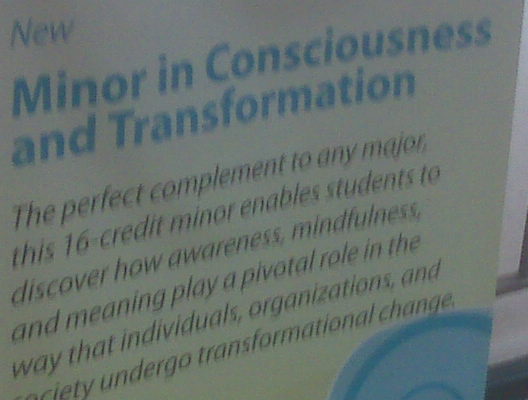
I was out at George Mason University’s Fairfax campus to be one of the speaker’s at a seminar being offered by the Department of Labor.

I’m all for exploring one’s own consciousness and, by steady and consistent effort, aligning better (I prefer to speak of alignment rather then engaging the overused and debatable term “transformation”). They don’t seem quite right as academic subjects.

Peace and light, E — Posted with WordPress for BlackBerry.

Similar Posts

  • | |

    It’s a Fine Line Between a Grimace and a Smile (and satcitananda murtaye)

    The New York Times just published a blog entry on the perils of faking happiness.   The first problem with the article was that I could not get to the study to see if I agreed that the actual premise was that “faking a smile” was what led to a deterioration in mood or feeling unduly pressured by a need to do so regardless of what was going on inside was the problem.  The second is the definitional problem of what it means to “fake” a smile.  I think it not unlikely that contorting the face into a fake smile (i.e., grimacing) because one feels one has to do so does not improve mood when one is in physical or emotional pain.  According to the little cover blog, though, those that made an attempt to smile from the inside by thinking a positive though–even though it was a conscious effort– did experience an improvement in their mood.

    Any good method actor will tell you that to make an outer expression believable, one has to cultivate inner thoughts to go with it (though that is still “acting”).  Having been taught by my mother by age six in preparation for my first school play performance, that to act I should try to “be an apple” a la Stanislovski, I disagree that intentionally putting a smile on your face cannot help improve your mood. It’s all in how you fake it ’til you make it.  I have long advocated to my yoga students, based on my personal experience with the practice of smiling whether I think I mean it or not, to try smiling on the outside improve mood.  Even leaving aside the inner experience, just walk down the street with an open posture and a smile on your face and see how people respond, though I caution to do this at your peril in New York.  When you smile at people and be polite, they generally respond in kind.  You are then much more likely to feel good than if you are scowling and rude and people respond back in kind.

    What on earth (or in heaven’s name) does faking a smile until you feel one have to do with satcitananda, you may find yourself asking yourself at this point.  The second line of the Anusara invocation is “satcitananda murtaye.” Murtaye, from the same verbal root as murti or statue, here is usually translated as saying that Siva (from the first line) embodies the characteristics of satcitananda, being (what I like to call is-ness), absolute consciousness, and bliss.

    Another way of looking at this phrase, though, is that when we open to the possibility of discovering our siva nature, which is the reason we practice yoga, and when we use the principles of alignment to help do so, then we discover how to be, if even for a moment, simply present, fully conscious, and blissful with the consciousness of the ultimacy of being.  In a word, when we soften and look within, using the knowledge and experience of our teachers and our practices, a smile of recognition lights us up.  If we start out having a bad day, feeling stressed or anxious or in pain, or just plain grumpy from reading the news, we just have to practice with more depth and sincerity to find the smile and not beat ourselves up if we are struggling to find the smile despite our desire and the intensity of our practice.

    Is that faking a smile or being the smile?  Does trying to smile when we are feeling blue really make us more unhappy?  I think it is all in how we do it.

  • | |

    Waiting for the Bus (In the Shadow of the Dome)

    In some ways, those who live near it just plunk their stuff on the grass and sit and wait, more detached from the long reach that touches just about every one. We can be oblivious to the dome, we can be oblivious of the light of spirit, but both exist and touch us regardless of whether we pay attention. The more we seek to become conscious and to participate, though, the more profound and deep will be our connection to ourselves and others.

    Peace and light, E — Posted with WordPress for BlackBerry.

  • | |

    A Favorite Sculpture (and the missing mentor)

    I have been walking past this sculpture regularly ever since I was a judicial clerk in 1987-1988.  It is in the plaza between the Federal and DC court houses.  It is dated in the subject matter.  The partner-associate relationship has shifted over the years, both from the inclusion of women in the law place and the changing economics.  The shift in economics to assume that most associates will not be partners because the firm simply does not have the space for more partners and because the associates feel freer to move around and for a whole host of other reasons, some more benign than others, has left new workers bereft of the support of a mentor.  In the disruption of the continuity of the workplace, those who stay are less motivated to serve as mentors and lose the delight and strength that comes from the action of mentoring.  Those who come into a workplace without a mentor never learn the way they could.  Although some of the changes are good, the missing mentor is indeed a loss.

    Though the sculpture reminds me of something lost, I love this sculpture, especially where it is set.  It is absolutely suited to its location and was made with great skill and love.

Leave a Reply

Your email address will not be published. Required fields are marked *

This site uses Akismet to reduce spam. Learn how your comment data is processed.