When I googled (that should not be a verb) “holiday madness” this morning, I got one million three hundred thousand hits. Yikes! Most relevant websites are about surviving shopping, over-eating, family, and travel. Madness in such a situation is a choice. We can choose what to consume, how much, when, and with whom. It is a choice whether “celebration” requires consumption beyond what our financial, physical, and emotional means permit.
The yamas and niyamas as revealed by Patanjali provide beautiful structure for thinking about the holidays.
Yamas:
Ahimsa–non-harming. Don’t consume more than is harmful to yourself, those who have created what you are consuming, and the earth.
Satya — truthfulness. Be honest with yourself about what is right for you to celebrate and observe and what brings meaning to you as a holiday celebration.
Asteya — non-stealing. Consuming beyond your means, especially financially, is a form of stealing (look at what generated the recession).
Brahmacharya — moderation (aligning with Brahma). Enjoy the offerings of the earth in a way that uplifts rather than sickens or detracts from spirit and self.
Aparigraha — non-greediness; non-covetousness. Enjoy what you have without coveting or trying in a detrimental way to have what others have and you do not.
Niyamas
Sauca — cleanliness, purity. Consume in a way that is healthy for yourself and the planet, that does not create illness, refuse, and waste.
Samtosha — contentment. Wherever you are, whatever you have, whatever is going on in your work and family life, think of that for which you are grateful, that which brings you happiness, and focus on what you have. Contentment is a practice.
Tapas — fire, ardor. Be on fire to practice, to shift, to make this a life-fulfilling year of generosity and compassion.
Svadyaya — study of text, self-study. Take the holidays as an opportunity to deepen your understanding of yourself, society, and your spiritual beliefs and how they interrelate.
Ishvara pranadhana — surrender, recognition of the spirit. Let go a little. Surrender to a sense of fullness. Allow the abundance and recognize it as a wondrous gift. Remember the word “holiday” is really two words: “holy day.” Make this time holy, whether or not you observe a particular religious tradition at this time of year or any other.


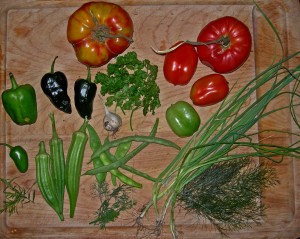 Could not resist the french name. More fun than summer local vegetable stew. An alternative name could be: how to make three okra and six beans into dinner for two. Or maybe four. When I was out in the garden this morning, I simply picked what needed to be picked. Featured here: three okra, six beans, one jalapeno, two ancho chiles (one partly dried on the plant), two large tomatoes (both of which are only partly viable), two ripe and one green (fell off while I was picking the ripe ones) roma tomatoes, one very small garlic clove, baby leeks, garlic chives, tarragon, parsley, dill, and herb fennel. Serve over quinoa, couscous, rice, or pasta, and it is easily a meal for two. Add some red beans or other dried beans, and it could be dinner for four.

Major insight so far is into my own apparent willingness to see these people as “other”.
It still seems superficial and cloying, almost. It’s tough for me to see anyone’s basic motivation as the least bit profound. If it works, then I have no objections, but I’ve always seen the world of the celebrity as the world of the eternal dilettante.