| |

Remembrance

I woke up this morning remembering. How could I not? People all over the world are remembering and thinking about the events of 9/11 and how they changed the course of global society.

And yesterday morning I woke up at my friend’s house in the East Bay to the news of the explosion in San Bruno. Even as we enjoyed the city and got together with another friend, the frightening and intense tragedy going on just a few miles away was not far from my mind. How is it that but for having read the news, we would not even have known?

This morning we will be going to hike in Muir Woods. I will be embracing nature and friendship, but still remembering. It is, I think, by loving and embracing life to the fullest that we can remember and have the most strength and will to offer of ourselves and move towards a more compassionate existence, and I think that is the true teaching of the tantric yoga.

What are you doing today? How are you sharing your memories and your dreams? What are you doing to help make the changes you wish to see in the world? I am asking myself these questions even as I am sharing them.

Similar Posts

  • | | | | |

    White Heat

    By 8:30 this morning, the sky was already an engorged white, thick with heat and humidity. There is no prospect of a thunderstorm for relief. If any come, they will be to the south and east or north and west of the space inside the Beltway. (I am convinced that the pattern of storms parting and dissipating within the Beltway is due to the hot air generated within the Dome).

    I walked to work earlier than usual this morning and wore a sleeveless dress, sandals, and a sun hat. The co-worker who shared the elevator was wearing a suit, tie, dark socks, and heavy shoes. A few of the men are brave enough to wear short sleeves or go without the tie, but all are wearing long pants, close-toed shoes, and dark socks. In the cafeteria, people are picking out foods heavy with meat, fat, and sugar. The building is air-conditioned to a temperature for the comfort of those who neither dress nor eat for the weather. In the building, I am wearing a wool cardigan over my weather appropriate dress.

    Last year, in response to a call to government workers from the White House for ideas to save money, I suggested that the dress code be changed from “business” attire to seasonally appropriate attire (my sleeveless dress is long and plain and does not expose anything other than my arms; it is perfectly “appropriate” and not beach wear). That way, the temperature in government buildings could be raised a few degrees in summer and lowered in winter, saving millions of dollars in heating and cooling expenses, as well as helping the environment.

    It needs to be a policy to wear clothing right for the weather. If it is not policy, those who want to get ahead will continue to believe that there is no possibility of succeeding without wearing the suit and tie/lined skirt and jacket, pantyhose and heels. (Why is it that people believe that our brains focus better when our clothing is uncomfortable?)

    I did not get a response. The winner was someone who suggested storing their office’s records electronically–something that is gradually happening every where in any event.

    Being seasonally appropriate in our dress and diet can make an enormous difference in our comfort and in our impact on the environment. Same, too, for how we exercise. When it is over 90F, please do not crank up the air conditioning so that you can do a fiery practice. Instead, practice quieter poses. Concentrate on seated poses, cooling pranayama practices, and meditation. Enjoy the invitation to stillness and the fact that by virtue of the heat, you are already warmed up.
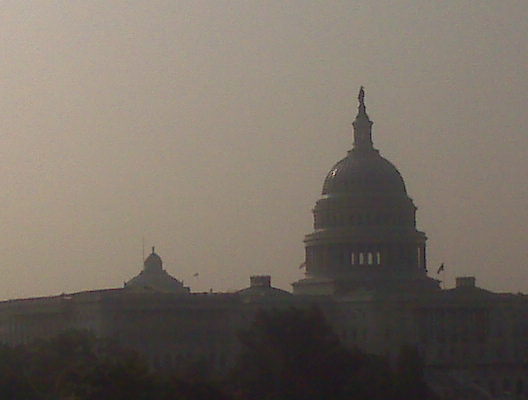
    Peace and light, E — Posted with WordPress for BlackBerry.

  • | | |

    “American Veda” (and some recollections)

    I am reading Philip Goldberg’s American Veda–From Emerson and the Beatles to Yoga and Meditation; How Indian Spirituality Changed the West.  It is another of the recently published works on the interplay and inter-influence of east and west.  What distinguishes American Veda is that it is more about how Indian spirituality influenced western/American society overall, than an analysis of the yoga that we practice in the west.  Much that one might expect to be in the book is there:  Emerson, Thoreau, Swami Vivekananda (and the Parliament of the World’s Religions), Ramakrishna, Paramahamsa Yogananda, Osho, Muktananda, the Beatles, Maharishi Mahesh Yogi, but there are other connections that are less well-known.

    As one generally familiar with the history of Indian philosophy and yoga practices coming to the West, it reads more like a survey or overview than an analysis to the extent that it tries not to leave out any one who could have been an influence and goes into little depth regarding any particular influence.  (Note:  the author himself says that the book is limited to Vedic/Hindu influences; he refers the reader to other sources, in particular, How the Swans Came to the Lake, for the transmission of Buddhism to the west).

    What is most interesting to me about reading American Veda is that it reads like old home week.  I recognize the names and the philosophies and the way people speak about spirituality and religion, and the author lovingly and thoroughly shows how profound and widespread is the influence of Vedic thought in America, even where no attribution is given.  I recognized even when I first discovered Indian philosophy texts in high school the interplay between how me and my fellow unprogrammed. liberal Quaker friends were talking about mystical experience and understanding of God/Spirit and the Indian philosophy, and it is lovely to have a book where someone went out and did all the research and gathered the sources.  By the time I was thinking about anything at all really, Indian philosophy was already something in my consciousness thanks to the Beatles and the Beats.  The Beatles discovered Maharishi Mahesh Yogi when I was six, which was the year that Sgt Pepper’s Lonely Hearts Club Band and Magical Mystery Tour came out and my parents for some now unfathomable reason gave them to me for my Christmas present.  My older sister and I played those albums over and over again on our portable record player, whirling ourselves into states of dizzy ecstasy with the sitar grooving in the background on our favorite songs.

    I was moved to read the Bhagavad Gita by reading J.D. Salinger’s Franny and Zooey. I do not remember whether this was in 9th or 10th grade, but I read Salinger because was what cool, smart kids read.  What I remember is that I read both Franny and Zooey and Catcher in the Rye (probably read the latter first) before Catcher in the Rye was assigned reading in 10th or 11th grade and that while I was not particularly impressed with Holden Caulfield, I really wanted to be as brilliant and educated and extraordinary and talented and philosophical as the children in the Glass family, and so I tried to read what they read (though alas, I read it in translation, where they were able to read the Greek and Latin and Sanskrit, etc.)   By 11th grade, a teacher had given me J. Krishnamurti to read, and his anti-guru guruness appealed to my Quaker sensibilities.

  • |

    A Letter from Tamil Nadu

    The attached photo of devotees at a kumkum-reddened shrine to Hanuman is just a taste of the extraordinary things I have been privileged to experience and witness in this journey.  I think that there as many reasons to go on a pilgrimage and as many experiences of it as there are people.  For both the challenges and the wonders, I have been given a chance to feel and shift and explore myself at the deepest levels.

    As you know, I had planned to take a mini-sabbatical from posting photos and writing while I was on the trip.  I was faced with an opportunity, though, from a lesson in both non-attachment and gratitude that opened up this opportunity to share.

    On our first full day in Madurai, we went to see the famous Meenakshi temple.  The experience at this temple was different from that we had in other temples for two significant reasons.  The first was that the inner sanctum was rigidly restricted only to Hindus.  Ironically, this correspondingly led to a permission to take photographs within the temple (usually forbidden) because we who are allowed only in the other parts of the temple are viewed more like tourists than worshippers.

    Right before we went to the temple, my camera reported that the battery was exhausted; intermittent power the night before must have prevented my getting it properly charged.  I took out my Blackberry as a second best alternative.  It had somehow turned itself on and depleted the charge looking for a radio signal even though I had turned off both the phone and Internet connections.  I couldn’t imagine making it through the rest of day without being able to take another photograph, and it appeared that I had no choice other than to call in what I have learned from yoga practice about non-attachment.  (Yes, I recognize that for even the most avid of amateur photographers, this was not a big loss).

    As grace would have it, though, a fellow enthusiastic photographer on the trip hearing of my predicament understood completely.  He had three cameras and his fiancee also had one.  He handed me the extra camera and showed me the basics.  The next day, he uploaded the photos I had shot onto my IPad, giving me a lesson in technology, along with the loan of the camera.  I may have avoided having to practice non-attachment for this minor moment of potential disappointment, but I was definitely gifted with a big opportunity to practice gratitude.  Having been the recipient of this gift, I wanted to share a little with you.

    I look forward to sharing more images and stories when I return, especially with all of my students when winter classes resume in January.

    Devotees of Hanuman

Leave a Reply

Your email address will not be published. Required fields are marked *

This site uses Akismet to reduce spam. Learn how your comment data is processed.