Midnight Yoga

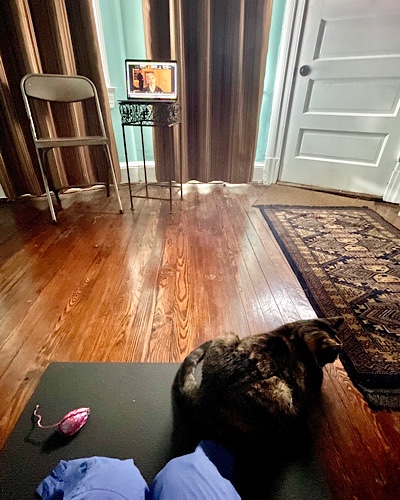
Every once and a while, I find myself restless at bedtime or wakeful in the night.  The following series serves to make it easier for me to go to sleep and for me to feel fully rested as if I had not been short sleep:

1.  Vipariti karani (legs up the wall).  Start with legs up the wall for five minutes or longer, then move legs into baddha konasana (butterfly) for several breaths, then put them back up the wall.  While your legs are up the wall, first just watch the breath.  Then concentrate on the breath, inviting the exhales to be twice the length of the inhales.

2.  Twisted forward bend.  Using a bolster and a folded blanket (or two or three folded blankets) lengthwise on your mat, place the left thigh next to the edge of the blanket pile, allow yourself to sit heavily.  Staying sweetly grounded, hug your hips together to embrace your core and then draw the left waist back as you bow forward onto the support of the blanket. You can allow your forearms and hands to rest on the floor or you can bend your elbows a little more and tuck your hands between the blankets under your forehead.   Keeping the attention on the breath, inhaling lovingly draw in, exhaling more fully accept the support of the blanket.  Hold for a few minutes and then repeat on the other side.

3.  Supported balasana (child’s pose).  With your knees wide apart and the big toes together, draw the blanket pile between your knees up to mid-thigh.  Place another blanket (or a pillow) across your calves.  Bow forward onto the support of the blankets.  Half way through, turn your head to the other side.  If your thoughts are still active, just let them be and turn your attention back to the breath.

4.  When you are ready to come out of balasana, tuck your toes under and lift your hips into adho mukha svanasana (downward facing dog).  If you’d like, you can stay here for several breaths with your head supported by the blankets.  When you are ready, walk your hands back to uttanasana (standing forward bend).  Quietly and mindfully get back into bed and lie in savasana.

Sweet dreams!

Similar Posts

  • | | |

    Historic Anniversary and Yogic Discernment

    January 6 is yet another day so historic it warrants reflection and impetus to action on every anniversary. (That might be resting, by the way, if you spend much of your temporal, energetic, and emotional resources in the efforts to make change and ward off evil.)

    One of the yoga practices is exercising discrimination and acting with discernment (viveka) in response to changes in the world, the human collective, and ourselves. Discernment requires learning and admitting to the difficult truths and learning from experts and innovators.

    Meditation, contemplation, reflection, and being present to oneself is all very nice, but without study and discriminative participation in the collective, it starts being more like spiritual bypassing than not.

    What are your thoughts on this day? How does staying present to the reality of it make you feel? How are you balancing taking care of yourself and participating in shifting the narrative?

    It seems somewhat fitting that DC has been crippled today by the first significant snow storm in quite some time.

  • | | | | | | |

    What Are You Going to Do With It?

    We all have one of these. The question is whether we can learn to use, repurpose, refine, release, and dissolve to best serve ourselves and our environment.

    Peace and light, E — Posted with WordPress for BlackBerry.

  • | | |

    Ecstatic Serenity

    When I was eight or nine, a teacher asked everyone in my class to say what they wanted to be when they grew up.  The other children named the various jobs or professions that appealed to them at the time.  I responded that I wanted to be independently wealthy.  At that age, I was expressing something I already knew from family issues.  Though I did not have the words for it or a clear understanding, what I was saying was not just false precocity.  I knew at a basic level what is taught in yoga:  I would need enough material support (ardha) to follow my heart in love (kama) and work (dharma); then my life could be free (moksha).

    When I was 22 and visiting my friend Dan, he asked me what I really wanted to do with my life.  We had just graduated from college.  Dan was working for a sculptor who was a professor in the art department; I had just moved back to New York, had just gotten over a failed attempt to serve as an office manager for an off-off Broadway theater, was in a place of deep emotional and financial struggle, and was trying to determine what work and corresponding further education I wanted.  “I want to be content,” I said.  “That’s too passive,” he replied.  “No, that’s not what I mean,” I tried to explain.  “For me being content being satisfied and engaged with my work and life, but still working hard and having goals.  It’s not just hanging out.”  I had all sorts of things that I found interesting and possibilities for a life path, but I didn’t have one specific career or life plan that I was certain would be more fulfilling than any of the others.  They just would have satisfied me in different ways.  Because of the dilemma of too many choices, I wanted to be able happy with whatever choice I made, even if it seemed like a compromise.  I was conscious that once I picked, because of the inherent limitations of time and space, that I would either have to be content with my choice or be unhappy.  I have since learned to think of contentment (samtosha), which is one of the niyamas of the path of yoga expounded by Patanjali, as a practice rather than a goal (and it is a very important and continuing practice for me).  Contentment is not an end, as I had thought when I was 22; it is just one part of the path to a goal of living liberated (jivanmukti), experiencing self as spirit in all that one does.

    On a recent telephone seminar, Paul Muller-Ortega, my meditation and philosophy teacher, in the midst of a broad dialogue regarding various studies and practices, spoke a little of ecstatic serenity.  Memories of the discussions I had had long ago about what I wanted welled up in the forefront of my thoughts.  In thinking about what is my intention now, especially with regard to my practice (sadhana), I witnessed my previously stated intentions as just stages on the path to this discovery.  As soon as I heard Paul say the phrase, I thought, “that’s what I want; I want to be ecstatically serene.”   I seek to be always in some part of my conscious being still and peaceful, while simultaneously being passionately engaged in what life brings to me and I bring to life.

2 Comments

  1. Yes, this practice is also a good afternoon nap alternative. Just do the savasana on your yoga mat.

Leave a Reply

Your email address will not be published. Required fields are marked *

This site uses Akismet to reduce spam. Learn how your comment data is processed.