Perception and Illusion (maya)

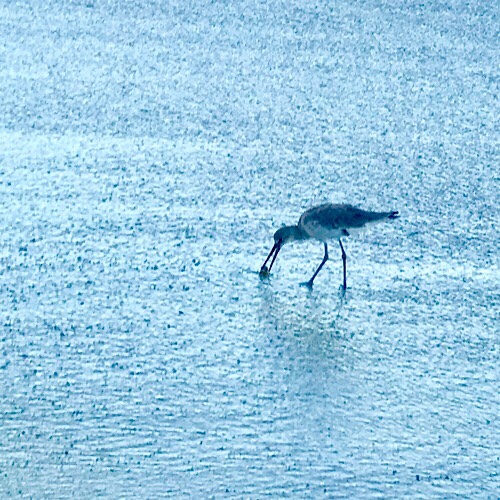
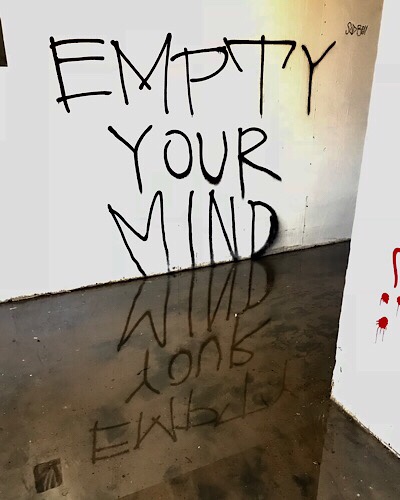
I have been thinking about perception and how as soon as we have more than one person looking at the same thing, each person has a different story, a different truth, a different explanation.  Add to that the mysterious systems humans have created:  information technology, cyberspace, monetary system.  All of these are energy fields.  We can only perceive small pieces of them, and we have varying degrees of skepticism about the reality of what we get from them.  It is not a hard leap from that to understand what the yogis are saying when they say what we receive through the senses is illusory (maya).

We read news articles about the fact that Yo-Yo Ma was not playing at the Inauguration, but just moving his hands over the instrument to a recorded tape.  Why would I believe the news stories more than I would believe what was on the “jumbo-trons” — or if I had been one of the few close in, what I’d thought I’d seen and heard?  Why would I be more likely to believe the Inauguration of President Obama if I saw it on TV than I would the story line of a movie?  How is it that we distinguish between news and fiction, our side of the story v. the other person’s side?

When we emphasize the “reality” of our own perception, we bring ourselves to schisms, disputes, and hurt feelings.  When we let ourselves be skeptical about our own perceptions and know that they are only one aspect of a unity (like the blind men and the elephant), then we can be softer, more open, and less divisive.  I am working on this; it is a challenging aspect of my yoga practice.  What do you think?
Similar Posts

  • | | | | |

    April Greetings–Delving into the Essential (Web Version of E-Newsletter)

    Dear Friends,

    It has been a mind-boggling several weeks.  The magnitude of the upheavals and the impact on all of the world, including human beings, is beyond my ability to grasp.  Closer up than the unfolding devastation in Japan and the escalating war in Libya, which daily adds to the bankrupting of this country and planet by our wars, I found myself supporting committed organizations, signing petitions, and writing emails saying that I preferred to be locked out of my work place with no pay than to have taken away any existing protection of the environment or provision health care for low income women.  As my mind tries to expand enough to stay present and active, I am more grateful every day to have and share the practice of yoga.

    Practicing helps us minimize suffering by changing how we relate to pain and the full range of human emotion.  The goal, I think, is to fully and joyously engage in life with an intention to live as harmoniously as possible with all beings, including our individual selves, and simultaneously appreciate and be wonderstruck at the extraordinary and wild vastness of being that makes the time and space of the known universe seem finite relative to life (lives) on earth.  When we can find both perspectives simultaneously, then we can be engaged, but not attached (vairagya).

    How do we focus this intention to live fully and harmoniously in this way?    In the past six weeks, I have had the unbelievably fortuitous combination of circumstances to be able to study with John Friend for three days; to attend the Mahasivaratri celebration with Douglas Brooks, Krishna Das, John Friend, Amy Ippoliti, and Sianna Sherman; Ross Rayburn for a weekend workshop at Willow Street;; Desiree Rumbaugh at a special three-hour practice the following week at Willow Street; and Paul Muller-Ortega via telephone conference.

    Wow, that was a whole lot of input for my practice and contemplation, while living itself was getting more intense.  But, it turned out not to be too much because of the singularity of the teachings.  The message I heard from all of these teachers in their own unique and inspiring voices was that is is a good time to get down to get back to basics, or to put it another way, to explore more deeply the essential principles of practice (and of life).  By getting back to the basics in the practice, we can start knowing at a deeper level what is essential for us to relate as deeply and joyously and non-harmingly (yes, I know it isn’t a word, but I’d like it if it were) on and off the mat to ourselves and all in our web of relationship.

    In both my practice and my public class offerings, this Spring, I am especially focused on exploring what is essential to experience life at its most joyous while still be conscious and committed to the need for effort to change.  In addition to continuing my regular class offerings, I am pleased to be offering a short course in restorative yoga at Willow Street, “Cultivating Relaxation with Restorative Yoga.”

    Restorative yoga is perfect whether you are looking for a gentler way to get started with yoga, an opportunity to relax, or alternative practices for when you are feeling stiff or in pain, or a way for advanced practitioners to explore the alignment principles at the subtlest levels. We will explore a variety of types of supported postures and prop-assisted stretches to enable you to relax into optimal alignment, discover your own space of deep rest and peacefulness, and open your body. The course will also offer simple techniques to ease into sleep, find mini-relaxation moments when things are hectic, and sweeten your home practice–what could be of better service these days?  Everybody welcome. 6 Thursdays, 4/21-5/26.

    To get news in between the occasional email offerings or to see my latest short thoughts, please “like” my new “Rose Garden Yoga” page on Facebook.

    I look forward to seeing you in person soon.  As always, please feel comfortable being in touch by comment on the blog or by email.
    Peace and light,

    Elizabeth

  • |

    “Yes We Can”

    Yesterday’s inaugural concert spurred all sorts of memories from me.  When I was a child, we went a number of times to the Clearwater Revival Festival and other folk festivals where Pete Seeger was a headline.  He is just ten years older than my Dad, and though my parents were not among those who became famous, they were hanging around the Village and my Dad was doing activist things at the same time.  James Taylor’s “Shower the People” was a favorite when I was in junior high school.  There was a boy from camp who played the guitar who I remember saying that “a little James Taylor goes a long way [towards getting a girl’s attention].”  Bruce Springsteen, John Cougar Mellenkamp, U2, Bob Marley, Aaron Copeland, and the great oldies (played at the concert and listed as Obama’s top ten ipod songs), are part of the music of my high school, college, and law school years.

    Not needing music or advertising to help me decide to vote, I didn’t pay much attention to how music was being used in the campaign.  But here was the music, and it was mostly my music, too.  The concert was very clever, designed to appeal to black and white, young and old, and populist — they were careful to have the performers whose oevre might not appeal to an older or younger crowd stick to songs with mass appeal.

    Interestingly, it gave me an insight to those conservative guys from the middle of the country who said they liked W because he was the kind of guy they could hang with and have a beer.  The concert was a concert I might have attended when I was in high school or college or law school.  I had an insight about what it feels like to feel comfortable with the education and background of the President, but only up to a point.  I enjoyed this trip down memory lane, but it did not impact my politics or how I would view the Presidency.  There is a fine line between relating and agreeing, appreciating and accepting without question.

  • |

    Mahabhutas (the great elements)

    The mahabhutas are the grossest, most physical of the 36 tattvas described in Kashmir Shaivism.  They are:  prithivi — earth or solidity; ap (or jala) — water or liquidity,  agni (or tejas) — fire or formativity; vayu — air;  akasha — space.  When we practice asana, we can focus our practice on discovering one of the elements in our bodies and how we move.  As we get more skillful, we can choose which element seems out of balance and emphasize one or the other to bring ourselves more into balance.  This week, for example, I have noticed that my mind has been scattered and distracted because of all of the excitement of the Inauguration.  After being blown about by the cold and the wind and all the excitement, I had gotten to airy (which is my tendency anyway).  It is a good time, therefore, to explore prithivi (earth) in my practice.  By emphasizing a strong foundation coupled with the Anusara principle of muscular energy, I can literally bring myself to a more solid, stable, and grounded state.

    We can work with the tattvas as described above, to realign our energies so that our physical and mental state is more balanced.  We can also explore the more concrete tattvas as we embody them to understand better how they are manifestations of the subtler tattvas — the tattvas that the great yogis who have described them would call more real and we dwelling in our bodies and minds might think of as observably less real.  Where we can best appreciate and experience the relationship between the gross and the subtle elements is in meditation, and our asana practice can help lead us there.

    Look forward this week to working with the earth element in your bodies and minds, practicing strong standing poses and shaping your physical and energetic bodies like clay.  Use your earth nature to sculpt the art of your intention.

    For suggested readings see my earlier post on the tattvas.

  • | | | |

    “Reality is Unforgivingly Complex”

    Yesterday, the first of the year, I pulled off the shelf and opened at random Anne Lamott’s “Bird by Bird.”  I’d found it used some time ago and was interested,  but other things got ahead of it on my reading pile.  The page to which I opened seems highly topical for what is coming this year:

    For instance, I used to think that paired opposites were a given, that love was the opposite of hate, right the opposite of wrong.  But now  I think we sometimes buy into these concepts because it is so much easier to embrace absolutes than to suffer reality.  I don’t think anything is the opposite of love.  Reality is unforgivingly complex.

    May we find enough love to suffer well the complexities to come this year.  For me, I know that deepening and recommitting to my practice will help me find what more I can offer.

Leave a Reply

Your email address will not be published. Required fields are marked *

This site uses Akismet to reduce spam. Learn how your comment data is processed.