|

Finding Ayyappa

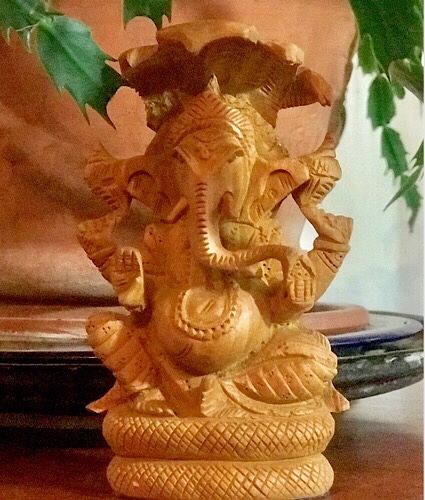
A couple of weeks ago, I found a carved wood murti of Ganesha in a box on the sidewalk with some other stuff and a “free” sign. This Ganesha had serpents (nagas) rising over his head like a canopy–not uncommon imagery. Ganesha was “free” most likely because one of the nagas had broken off. It made me think of Ayyappa, Ganesha’s brother by a different mother. Ayyappa is apart from the others. Of Shiva’s three sons, he is the one who is either or both missing or extra. The trunk was also badly glued, but that can be remedied.

Similar Posts

  • | |

    Found Exhortation?

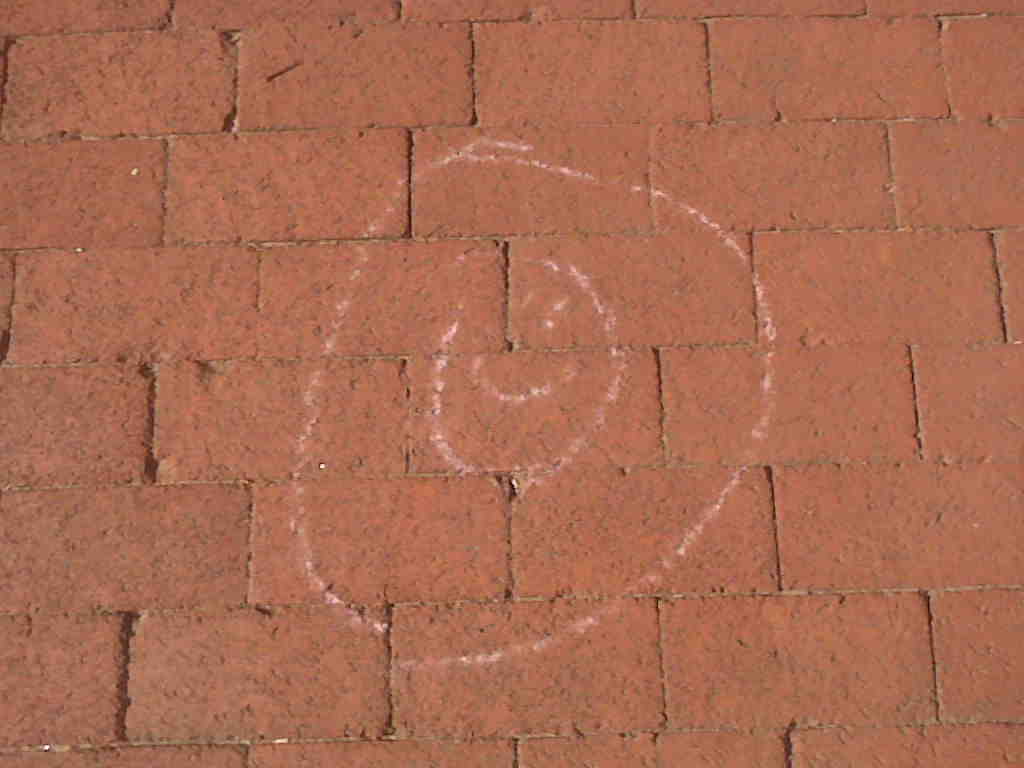
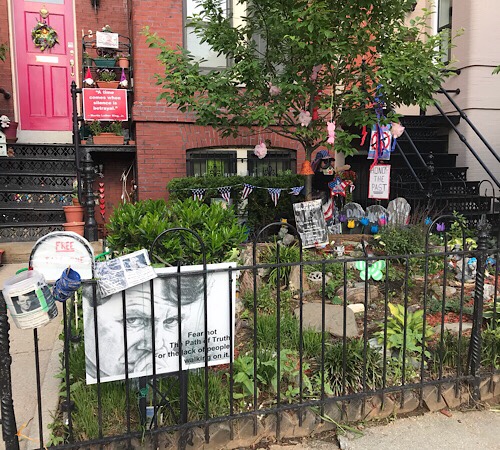
    Someone has been walking around Capitol Hill with pink chalk and drawing circles with smiley faces inside. Impermanent graffiti made longer lasting by the drought. What is the message intended? How many people have noticed (at least one friend of mine has asked about this offering on Face Book)?

    Peace and light, E — Posted with WordPress for BlackBerry.

  • | |

    Laying Down the William Penn House Practice (Last Practice May 15)

    Perhaps because it has been hosted at a place that fosters the Quaker way of doing business, but when I first tried to describe why I thought it was time to leave off having a regularly scheduled practice at William Penn House, the first phrase that came to mind, was that the practice was being “laid down.”

    Very generally, much Quaker business is done by a committee consisting of members who are nominated by the meeting and willing and able to address whatever the issue that is the purpose of the committee. A committee may be formed to address a particular issue that a meeting is encountering or for general ongoing work for the life of the meeting. After a committee’s purpose is done–which may or may not be clear, depending on the nature of the issue–the meeting may choose to lay down the committee. Laying down a committee is not passing judgment. Sometimes, the committee has served its purpose well, but is no longer needed as much as the resources of the committee (it’s members) are needed elsewhere–either for the meeting or for their own personal lives.

    The William Penn House group practice started over 10 years ago. Its initial purpose was to keep going a class from a studio that closed for several months. Having the practice at William Penn House was also a good way to create neighborhood, Quaker, and yoga connections, provide support for the work of William Penn House, and provide an unconventional community donation practice space.

    In the years since the class was established, the whole tenor and climate of the world has changed. The neighborhood, too has changed. Among the changes, there are now several yoga studios on the Hill and there are lots of choices for a practice every night of the week without leaving the neighborhood. In the broad group that has participated in the practices, there have been graduations, marriages, births of children and grandchildren, illnesses, injuries, world travel, joys and sorrows, death, career changes, and it is time for those still in the habit of Tuesday night practice to reconfigure what and when we practice for our own good and for the great web, including together.

    I will always be grateful to all the practitioners/friends who joined with me in collective exploration of the practices and to William Penn House for being a welcoming and nonjudgmental host for a really long time.

    As a member of the Board of Directors and a neighbor, I will still be part of the life and practice at William Penn House. I am still offering small group and private classes in my lovely home studio. Send me a message, if you’d like to practice. I’m looking forward to scheduling practice on a more flexible basis.
  • | |

    Shiva-Shakti Tattvas

    The shiva-shakti tattvas, the two highest tattvas, are completely subjective.  The shiva tattva is, according to the philosophy, the ultimate reality, the pure “I,” undiminished and undifferentiated consciousness.  As something purely subjective, it is both everywhere and nowhere, in every being and simultaneously beyond them.  It is not dissimilar to Hegel’s Absolute (though I believe Douglas Brooks, who knows far more than I in this area, might disagree with me on this one), which “is and is not,” or Kant’s “unmoved mover.”

    Shakti tattva is power — the power to tranform, create, manifest, diversify, cloak.  Shakti is the power to become embodied in objective form.  Shiva and shakti tattvas are thus inseparable.  Ultimate unbounded consciousness and freedom (shiva) only has meaning to the extent the power to move, create, and diversify (shakti) pulses and transforms the subjective into the objective, the unimaginable to the observable.

    In our yoga practice and meditation, we seek to use the practices to reveal to ourselves the ultimate pulsation (spanda) between the objective and subjective, the observable and the unknowable, the individual and the completely universal.  One way I experience the first principle of Anusara yoga (open to grace), is taking the mat or my seat with an openness to sense and experience this ultimate pulsation (spanda) and play (lila), so that by using my body, mind, and will, I can better recognize the spirit that shines in all of us and use that recognition to inform how I relate to myself, society, and all beings.

Leave a Reply

Your email address will not be published. Required fields are marked *

This site uses Akismet to reduce spam. Learn how your comment data is processed.