|

Taking Woodstock (and spanda)

Kashmir shaivism, using the term spanda, talks of the ultimate pulsation of life itself, all being a vibration, everything a play of opposites, a constant dance of concealment and revelation.

Yesterday I when I went to see Ang Lee’s Taking Woodstock, I thought about about what a dance of moments, desires, emotions, motivations, opportunities, and relationships made Woodstock the phenomenon it became.

I remembered when I was a teenager asking my mother why we had not gone; I had some idea that good family friends had made the trek from Long Island.  She said it did not seem sensible to bring three girls under 10.  I am sure that if we had gone, my memories would have been of being dirty, hungry, tired, wet, and overwhelmed.  Instead, I grew up with the instant nostalgia of someone who was just a few years too young to make it up there on my own.  In this contemplation, I marveled nearly as much at the play of spanda in my own life as in the world around me.

Similar Posts

  • |

    Happy Thanksgiving?

    Last night as I waited on the metro platform at Takoma Park after yoga class, a large man in a shabby black coat came up to me and said, “happy thanksgiving.”

    “Happy thanksgiving,” I replied, thinking I like Thanksgiving better than I like Valentine’s Day, even considering the somewhat unsavory roots of both holidays.

    “Oops,” he said, “I meant ‘happy Valentine’s Day; I’ve been getting that wrong all day.”

    “That’s OK,” I said.  “Every day should be a day of thanks giving.”  I had been enjoying the day fully even though I had not engaged in any Hallmark-driven behavior and was feeling fully grateful for my life and not just because of the post-yoga class glow.

    “I don’t have anyone to give red roses to any more,” the man lamented.  “My mother has passed; my grandma has passed.  I don’t have a girl right now.”

    “Your mother and grandma are still here in your heart, and they know you love them.  They do not need roses,”  I offered.  “In fact, you have helped the world be a better place not buying any roses today.  Most bouquets of roses are laden with pesticides and cut and wrapped by women in poor countries who get sick from the pesticides.”  At this, a young woman watching me with commiseration lit up with a big smile.  Who would start giving advice on the hazards of Valentine’s Day flowers — I restrained myself from talking fair trade chocolate — in this situation?

    “You’re nice,” the man said, “what’s your name?”  The metro was still not due for another eight minutes, and, being the introverted, cautious, small, middle-aged woman that I am and thus feeling a little pressured by his longing for someone to talk to, I did the verbal dance to extricate myself from the conversation and get back to the email I had been in the middle of reading.  He went away peaceably, so it was alright.

  • | | | |

    Bhakti

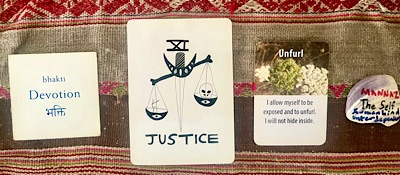
    I went down to the White House and joined a prayer vigil for ceasefire and disarmament in the Middle East led by the Franciscan Action Network. Another group was beginning a march on front of the World Bank, pointing out the conflation of oil and gas dependence, continued bombing, and ecocide. Such action is bhakti (spiritual devotion), not empty prayers combined with a niceness that passively allows the status quo.

    How are you living your faith?

  • | |

    Durga Yantra

    Last night at dinner a friend noticed my necklace and asked about it.

    “My friend Eleanor Drabo, who is at Eastern Market on the weekends, and is a wonderful artist and jewelry designer, made it for me,” I told her.

    “Did you draw the image?” she asked.

    “I asked for the basic design,” I explained, “it’s the central part of the yantra for the Goddess Durga. She’s the Goddess who had to slay the demon the the male gods made so powerful they couldn’t get rid of the demon themselves. I had it made of scrap gold–broken jewelry I’d found over the years at yard sales, a couple of unstylish single earrings that might have been a grandmother’s, and the custom ring from my former marriage.”

    “That sounds like a story for your blog,” she suggested, “such a transformation.”

    “It could be.”

  • | | | |

    Each One, Reach One

    I went with a friend from volunteering at the youth garden yesterday morning to join with others to heighten awareness of the potential impact on the fabric of our fragile democracy of what the current Supreme Court decides in Moore v Harper, which was being argued.

    We got to talking to one of the fellow demonstrators. I had pictures of N (for more from N, see @blacklivesmattermemorialfence), from a previous demonstration relevant to voting rights earlier in the year. After we confirmed the connection, N asked me if I was a lawyer for the government; it turns out N also remembered that I had given directions and ended up walking a few blocks together to the gathering near the Capitol for the one year anniversary of the January 6th insurrection.

    We all talked about impact and whether it makes a difference if we only inspire a few people. I shared a story about one of the very few comments saying I had inspired being more politically active and outspoken in the yoga context. Maybe, I conjectured, it doesn’t matter if we only reach one person, because we don’t know who is that person and how they will be moved. N plans to make a t-shirt that says, “each one, reach one.”

    To whom will you reach out? What moves you?

  • |

    Adhikara

    I was first taught that adhikara meant “studentship.”  Although that is not a literal translation, adhikara implies a dedication and steadiness in the student that makes the student worthy of receiving the teachings (of yoga).  As I was steadying myself during this momentous time and working in the garden, I was thinking about how the principle of adhikara applies to so many aspects of life, including gardening and being a citizen.

    One of the literal translations for adhikara is “competence.”  What is the competence one needs to have in order to participate in the study?  As I harvested the last of the peppers and eggplants and pulled up the plants, making room to sow another round of greens (not too late in my sunny, protected yard in the city), and decided to leave the orchids out for another week, I thought about how I knew what to do when in my garden.  By being present and observant for two decades in my yard alone, I have grown competent to know what will likely grow in my little patch of earth and for how long into the season, depending on the year’s weather.  My initial competence, when I started this garden almost 20 years ago, was some basic training in other gardens, reading technical books, and enthusiasm.  My consistent efforts to learn yielded results delightful to me from the beginning.  As I have continued my studentship in the garden, my appreciation grows.  The same is true for me also with cooking, relationships, and my participation in the community (not necessarily in that order).

    The fundamental competence of a student is having the basic skills to participate at the level of the teachings.  For a gardener, it is recognizing our climate, our space limitations, and our soil, and being open to learning what can be changed in a particular space and what must be accepted.  For a citizen, it is knowing basic civics, what are the most relevant issues for us and society at large, and what we can change and what we must accept (I think knowing the subtle differences between what we can change and what we must accept is incredibly difficult).  For yoga, it is much the same:  we must know what are true limits and what are false ones and be consistently present, practice steadily, and be ever open, not only to studying, but to the fruits of study (expected or not).

    I cannot change the weather, nor guarantee how other voters will vote, but I can continue to maintain the adhikara necessary to be a fully engaged student of this life on all days and not just the days it is fun or gratifying.  The yoga, on a day like today, is to act fully, accepting, and perhaps even appreciating, the limits on what I can control.


Leave a Reply

Your email address will not be published. Required fields are marked *

This site uses Akismet to reduce spam. Learn how your comment data is processed.